

Introduction
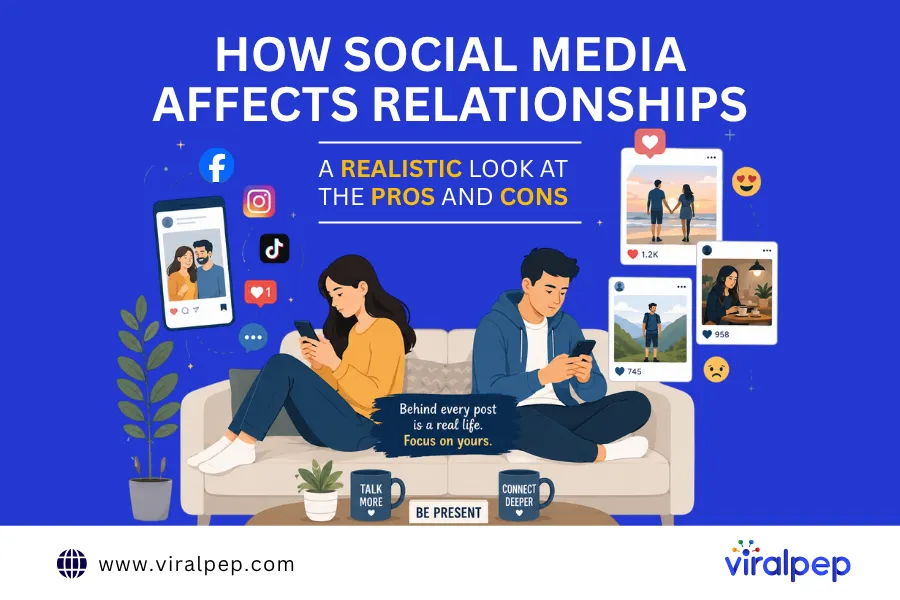
Social media has become a central part of how people connect, communicate, and maintain relationships. Whether it is friendships, family bonds, or romantic relationships, much of the interaction that once happened in person now continues online.
This shift has led to a common concern. Many believe that social media is damaging relationships by reducing meaningful interaction, creating misunderstandings, and encouraging comparison. While these concerns are not without merit, they only tell part of the story.
Social media does not affect all relationships in the same way. Its impact depends largely on how it is used. For some, it strengthens connections by making communication easier and more consistent. For others, it introduces challenges that can strain trust and emotional balance.
The key is to move beyond a one-sided view. Social media is neither entirely harmful nor entirely beneficial. It is a tool that can support or disrupt relationships depending on habits, boundaries, and intent.
This article explores how social media affects relationships in a practical and balanced way. It looks at both the positive and negative influences, and what individuals can do to ensure that their use of social media supports healthier, more meaningful connections.
How Social Media Has Changed the Way We Connect
The way people build and maintain relationships has changed significantly with the rise of social media. Communication is no longer limited by time or location. Instead of waiting to meet in person or speak at a specific time, interactions now happen continuously throughout the day. Research on the impact of social media on friendships shows that constant connectivity has become a defining part of how relationships are maintained today.
This constant connectivity has created a new normal. Friends, partners, and family members can stay updated on each other’s lives in real time. A message, a comment, or even a simple reaction can keep a connection active without requiring a full conversation.
At the same time, social media has introduced new forms of interaction. Sharing updates, posting stories, and reacting to content have become part of everyday communication. These actions may seem small, but they contribute to how relationships are maintained over time.
Another change is the visibility of relationships. Moments that were once private are now often shared publicly. This can create a sense of closeness, but it also introduces external influence, where others can see, react to, and sometimes shape how relationships are perceived.
There is also a shift in expectations. Because communication is always possible, there can be an assumption that responses should be immediate. Delays in replying or reduced interaction can sometimes be misinterpreted, even when there is no negative intent.
These changes do not necessarily weaken relationships, but they do alter how they function. Social media has made connections more immediate and visible, while also adding layers of complexity that did not exist before.
Understanding this shift is important before evaluating whether social media is helping or harming relationships. It sets the context for how modern relationships are experienced and maintained.
Strengthening Relationships Through Communication
One of the most immediate ways social media affects relationships is through communication. At its best, it makes staying connected easier, more consistent, and less dependent on physical proximity.
For friends and family members who live in different cities or have busy schedules, social media helps maintain regular contact. A quick message, a shared post, or a short conversation can keep the relationship active without requiring significant time or effort. This continuity helps prevent relationships from fading due to distance or routine.
It also supports ongoing interaction in smaller ways. Not every conversation needs to be long or deeply structured. Responding to a story, reacting to a post, or sending a brief update allows people to stay involved in each other’s lives without formal communication. Over time, these small touchpoints build a sense of familiarity and presence. This becomes more effective when individuals focus on creating meaningful content online rather than just reacting passively.
In romantic relationships, social media can help maintain connection throughout the day. Checking in, sharing moments, or simply staying aware of each other’s activities can create a sense of closeness, especially in long-distance situations.
Another important aspect is accessibility. Social media gives people multiple ways to communicate, whether through text, voice, or visual content. This flexibility allows individuals to choose how they express themselves, which can improve the overall quality of interaction.
However, the benefit comes from how these tools are used. When communication is intentional and respectful, social media strengthens relationships by making interaction more consistent and accessible. It does not replace meaningful conversation, but it supports it by keeping connections active between those moments.
In this way, social media acts as an extension of communication rather than a substitute for it.
The Role of Social Media in Building New Relationships
Social media has not only changed how existing relationships are maintained, but also how new ones are formed. It has expanded the ways in which people meet, interact, and connect with others beyond their immediate environment.
In the past, most relationships developed through shared physical spaces such as schools, workplaces, or social circles. Social media removes many of these limitations. People can now connect based on shared interests, ideas, or experiences rather than just location. Communities built around user-generated content on social media often create stronger connections because they are based on shared participation rather than passive interaction.
This makes it easier to find like-minded individuals. Whether someone is interested in a specific hobby, subject, or perspective, there are communities built around it. Engaging in these spaces often leads to conversations, collaborations, and eventually, meaningful connections.
Another important factor is accessibility. Starting a conversation online can feel less intimidating than approaching someone in person. This lowers the barrier for interaction, especially for individuals who may be more reserved. Over time, repeated interactions can lead to familiarity and trust.
Social media also allows relationships to develop gradually. Instead of immediate, direct interaction, people can observe, engage lightly, and build comfort before forming a stronger connection. This can lead to more intentional and interest-based relationships.
However, the quality of these connections depends on how they are developed. Superficial interactions may not lead to meaningful relationships, but consistent and genuine engagement often does.
In many cases, online connections extend beyond the digital space. Friendships and professional relationships that begin on social media can move into real-world interactions, creating a blend of online and offline connection.
Overall, social media has expanded the scope of relationship building. It provides more opportunities to connect, but it also requires awareness and effort to turn those opportunities into meaningful relationships.
Where Social Media Creates Distance
While social media can make communication easier, it can also create a sense of distance in relationships when interaction becomes more surface-level than meaningful.
One of the most common shifts is the replacement of direct conversation with passive interaction. Instead of talking about experiences, people may rely on viewing updates, liking posts, or sending brief reactions. These actions create a sense of connection, but they do not always lead to deeper understanding.
Over time, this can reduce the quality of communication. A relationship may appear active because of frequent online interaction, but the actual exchange of thoughts and emotions may become limited. This creates what can be described as an illusion of connection, where people feel involved in each other’s lives without truly engaging.
Another factor is distraction. When communication is constantly interrupted by notifications, multitasking, or switching between conversations, it becomes harder to give full attention to any one interaction. This can make conversations feel incomplete or less meaningful.
Social media can also reduce the need for intentional effort. Since it is easy to stay loosely connected, individuals may invest less time in planning conversations or spending time together in person. As a result, relationships that rely only on digital interaction may lack depth over time.
There is also the issue of misalignment. One person may view regular likes or short messages as sufficient interaction, while the other may expect more direct and meaningful communication. This difference in expectations can lead to dissatisfaction even when both individuals are active online.
These effects do not mean that social media damages relationships by default. However, when it replaces rather than supports meaningful communication, it can create distance instead of reducing it.
Comparison, Jealousy, and Misunderstandings
One of the more subtle ways social media affects relationships is through comparison and interpretation. Unlike direct communication, social platforms present curated snapshots of people’s lives, often highlighting positive moments while leaving out context.
This creates an environment where individuals may begin to compare their own relationships with what they see online. Photos, posts, and public interactions can give the impression that others are experiencing more meaningful or fulfilling connections. Over time, this can lead to unrealistic expectations and dissatisfaction, even when there is no actual problem in the relationship. Studies on social media and relationship dynamics suggest that curated content often contributes to comparison and emotional misinterpretation.
Jealousy can also emerge from how interactions are perceived. Studies on social media jealousy and relationship behavior show that online monitoring and uncertainty can influence how partners communicate and react to each other. A like, a comment, or a new connection may seem insignificant to one person but carry meaning for another. Without clear communication, these small actions can be misinterpreted and create unnecessary tension.
Another challenge is the lack of tone and context in digital communication. Messages can be read in different ways depending on the reader’s mood or assumptions. A short reply might be seen as disinterest, while a delayed response could be interpreted as avoidance. These misunderstandings can escalate if they are not clarified.
Public visibility adds another layer. When parts of a relationship are shared online, they are open to observation and reaction from others. External opinions, even when unintended, can influence how individuals perceive their own relationships.
It is important to recognize that these issues are not caused by social media alone, but by how information is interpreted within it. When individuals rely heavily on assumptions rather than direct communication, the likelihood of misunderstanding increases.
Clear and honest conversation remains the most effective way to address these challenges. Social media may introduce new triggers, but the way they are handled determines their impact on the relationship.
Trust Issues and Privacy Concerns
Trust is a central part of any relationship, and social media can both support and challenge it depending on how it is used.
One of the main concerns is increased visibility. Social platforms make it easy to see who someone interacts with, what they engage with, and how they present themselves publicly. While this transparency can create openness, it can also lead to overanalysis. Small actions such as liking a post or following someone new may be interpreted in ways that were never intended. Research on social media and romantic relationship dynamics shows that increased visibility can sometimes lead to jealousy, validation-seeking, and trust concerns.
This often leads to overchecking behavior. Constantly monitoring a partner’s or friend’s activity can create unnecessary doubt and anxiety. Instead of building trust, it shifts the focus toward suspicion and validation.
Privacy is another important aspect. Not all parts of a relationship are meant to be public, but social media can blur these boundaries. Differences in comfort levels around sharing can lead to conflict. One person may prefer to keep things private, while the other may be more open about posting personal moments.
There is also the question of boundaries. Social media creates access, but it does not define limits. Without clear understanding, individuals may feel obligated to share more than they are comfortable with or respond more quickly than they would prefer.
Misunderstandings can arise when expectations are not aligned. For example, one person may see online transparency as a sign of honesty, while the other may see it as unnecessary exposure. These differences are not always discussed directly, which can lead to tension over time.
At its core, trust is not built through constant visibility, but through consistent and honest behavior. Social media does not replace this foundation. It simply introduces more situations where trust can either be reinforced or questioned.
When boundaries are clear and communication is open, social media is less likely to create issues around trust. Without these, even small interactions can become sources of concern.
Social Media and Emotional Dependency
Another way social media affects relationships is through the role it plays in emotional validation. Many interactions on these platforms are tied to responses such as likes, comments, and replies. Over time, these signals can begin to influence how individuals feel about themselves and their relationships.
When communication becomes closely linked to these forms of feedback, there is a risk of developing dependency. For example, the absence of a response or a delay in interaction may be interpreted as disinterest, even when that is not the case. This can create unnecessary concern or tension.
In relationships, this dependency can shift expectations. Instead of focusing on the quality of interaction, attention may move toward the frequency of responses or visible engagement. A message left unanswered for a short time or a lack of public interaction can carry more weight than it should.
There is also the influence of public validation. When aspects of a relationship are shared online, the response from others can affect how it is perceived internally. Positive reactions may reinforce a sense of connection, while limited engagement may lead to doubt, even if the relationship itself is stable.
Over time, relying too heavily on digital signals can reduce emotional independence. Instead of direct communication, individuals may look for reassurance through online activity. This can make relationships more sensitive to small changes in behavior.
It is important to recognize that social media interactions are only a small part of a relationship. They do not fully represent feelings, intentions, or commitment. When individuals maintain this perspective, it becomes easier to avoid placing too much importance on digital responses.
Developing awareness around these patterns helps reduce dependency. By focusing on direct communication and real interaction, relationships are less likely to be influenced by fluctuations in online engagement.
The Positive Side When Used Intentionally
Despite the challenges discussed, social media can have a positive impact on relationships when it is used with intention and awareness.
One of the most valuable aspects is consistency in communication. Staying in touch does not always require long conversations. Regular check-ins, shared updates, and simple interactions can help maintain a sense of connection, especially when people are busy or physically apart.
This is particularly important in long-distance relationships. Social media allows individuals to remain involved in each other’s daily lives, even when they cannot meet frequently. Sharing moments, thoughts, or experiences helps reduce the feeling of distance and keeps the relationship active. Learning to provide value on social media also improves how individuals communicate and engage meaningfully with others online.
It can also strengthen bonds through shared experiences. Watching the same content, discussing posts, or engaging with similar interests creates common ground. These shared interactions can lead to deeper conversations beyond the platform itself.
Another benefit is the ability to express thoughts more comfortably. Some individuals find it easier to communicate certain ideas or emotions through messages rather than in person. When used thoughtfully, this can improve understanding and reduce hesitation in communication.
Social media can also act as a reminder to stay connected. In busy routines, it is easy to lose touch, but platforms provide opportunities to check in, acknowledge important moments, and maintain relationships over time.
The key difference lies in how these tools are used. When social media supports communication rather than replacing it, it adds value. When it is used to complement real interaction, it strengthens relationships instead of weakening them.
Intentional use shifts the focus from passive scrolling to meaningful engagement. In doing so, it allows social media to play a constructive role in maintaining and improving relationships.
What Makes Social Media Healthy or Harmful in Relationships
By this point, it becomes clear that social media itself is not the deciding factor in whether relationships improve or decline. The outcome depends on how it is used and the habits that develop around it. Even in personal contexts, applying a basic social media strategy can help individuals use platforms more intentionally rather than reactively.
One of the most important factors is intention. When social media is used to communicate, stay connected, or share meaningful experiences, it tends to support relationships. When it is used out of habit or without awareness, it often leads to passive interaction and reduced engagement.
The quality of communication also matters. Frequent interaction does not automatically mean strong communication. Short responses, delayed replies, or distracted conversations can create misunderstandings if they replace more thoughtful exchanges. Relationships benefit more from clarity and consistency than from constant but shallow interaction.
Boundaries play a key role as well. Every relationship has different comfort levels when it comes to sharing, privacy, and availability. Without clear boundaries, expectations can become unclear. This can lead to frustration when one person expects immediate responses or more openness than the other is comfortable with.
Another factor is content exposure. The type of content individuals engage with influences how they perceive their own relationships. Constant exposure to idealized or curated content can lead to comparison, while balanced and realistic content helps maintain perspective.
Self-awareness is equally important. Recognizing how social media affects mood, attention, and expectations allows individuals to adjust their behavior. Without this awareness, it is easy to fall into patterns that negatively affect communication and trust.
In simple terms, social media becomes harmful when it replaces meaningful interaction, creates unrealistic expectations, or leads to overdependence. It becomes beneficial when it supports communication, respects boundaries, and is used with intention.
The difference is not in the platform, but in the approach.
Practical Guidance for Individuals and Couples
Understanding the impact of social media on relationships is useful, but the real value comes from applying that understanding in daily behavior. Small adjustments in how social media is used can significantly improve communication and reduce unnecessary tension.
For Individuals
The first step is awareness. Paying attention to how social media affects mood, expectations, and reactions can help identify patterns that may not be obvious at first. For example, noticing whether certain content leads to comparison or whether delayed responses create anxiety can provide useful insight.
Intentional use is equally important. Instead of opening social media out of habit, it helps to have a clear purpose, whether it is to connect with someone, share something meaningful, or engage with useful content. This reduces passive scrolling and makes interactions more focused.
Managing expectations also plays a role. Not every message requires an immediate response, and not every interaction needs to happen online. Understanding this helps reduce pressure and prevents unnecessary misunderstandings.
It is also helpful to maintain balance. Social media should complement real-life interaction, not replace it. Making time for direct conversation and in-person connection ensures that relationships are not limited to digital communication.
For Couples and Close Relationships
Clear communication is essential. Discussing how each person views social media use can prevent confusion later. This includes preferences around response time, privacy, and what is shared publicly.
Setting boundaries helps maintain comfort and trust. These boundaries do not need to be restrictive, but they should be clear. For example, agreeing on what aspects of the relationship remain private can reduce potential conflicts.
It is also important to avoid assumptions. Social media interactions can be easily misinterpreted, so it is better to ask directly rather than draw conclusions based on limited information.
Focusing on quality over quantity improves interaction. Instead of constant short exchanges, meaningful conversations create stronger connections. Social media can support communication, but it should not replace deeper discussions.
Finally, maintaining independence within the relationship is important. Relying too heavily on digital interaction for reassurance can create unnecessary dependency. A healthy relationship benefits from both connection and individual space.
When individuals and couples approach social media with clarity and balance, it becomes easier to avoid common pitfalls. Instead of creating tension, it can support communication and strengthen relationships over time.
Where Tools and Structure Help
As social media becomes a constant part of communication, one of the challenges is not access, but how that access is managed. Without structure, it is easy for usage to become reactive, inconsistent, or overwhelming, which can indirectly affect relationships.
One common issue is overuse. Constant notifications and frequent checking can interrupt conversations, reduce attention, and create a sense of being always available. Over time, this can affect how present individuals are, both online and offline.
Structure helps address this. Setting specific times for checking social media or responding to messages can reduce distraction and improve focus during conversations. It also creates more predictable communication patterns, which can reduce misunderstandings around delayed responses.
For individuals who use social media more actively, whether for content creation or regular communication, planning becomes important. Instead of engaging randomly throughout the day, organizing when and how content is shared allows for more intentional use.
This is where tools designed for social media management can be useful. They allow users to plan posts, schedule updates, and manage activity without needing to be constantly active on the platform. This reduces the need for continuous engagement while maintaining consistency.
For example, platforms like Viralpep provide ways to organize and automate parts of social media usage. This can help individuals and organizations maintain a structured presence without letting it interfere with personal interaction or relationships.
The goal of using such tools is not to increase activity, but to make it more controlled and purposeful. When social media is managed rather than constantly checked, it becomes less likely to disrupt communication and more likely to support it.
In this way, structure and the right tools can help create a healthier balance. They allow individuals to stay connected without letting social media take over the time and attention that relationships require.
Conclusion
Social media has become deeply embedded in how relationships are formed and maintained. It has made communication faster, more accessible, and more consistent, while also introducing new challenges that did not exist before.
Its impact is not one-dimensional. On one hand, it helps people stay connected across distance, maintain regular interaction, and build new relationships based on shared interests. On the other hand, it can create misunderstandings, encourage comparison, and shift attention away from meaningful communication when used without awareness.
The key difference lies in how it is used.
When social media supports communication, respects boundaries, and is used with intention, it can strengthen relationships. It becomes a tool that keeps connections active and relevant. When it replaces direct interaction, creates unrealistic expectations, or leads to dependency, it can have the opposite effect.
For individuals and couples, the focus should not be on avoiding social media, but on using it in a way that aligns with the needs of the relationship. Clear communication, mutual understanding, and balance are more important than the platform itself.
As digital interaction continues to grow, relationships will continue to evolve with it. Learning how to manage this shift is essential. Social media will remain part of everyday communication, but its role in relationships will always depend on the choices people make while using it.
Frequently Asked Questions
How does social media affect relationships?
Social media affects relationships by changing how people communicate and interact. It can strengthen connections through regular communication, but it can also create misunderstandings, comparison, and dependency if not used carefully.
Can social media improve relationships?
Yes, social media can improve relationships when used intentionally. It helps people stay connected, especially over distance, and supports ongoing communication through small but consistent interactions.
Does social media cause problems in relationships?
It can contribute to problems such as jealousy, miscommunication, or trust issues, especially when there is a lack of clarity or excessive reliance on online interaction. However, these issues are often related to usage patterns rather than the platform itself.
How can couples use social media in a healthy way?
Couples can use social media in a healthy way by setting clear boundaries, communicating openly about expectations, and focusing on meaningful interaction rather than constant online presence.