7 Signs Your Social Media Strategy Is Not Working

Introduction

Social media marketing continues to evolve rapidly in 2026, making it more important than ever for businesses to have a clear and effective strategy. Simply posting content regularly is no longer enough to build engagement, attract customers, or grow a strong online presence.

Many businesses remain active across multiple platforms but still struggle to achieve meaningful results. Low engagement, slow audience growth, weak brand visibility, and declining reach are often signs of deeper strategic issues rather than a lack of effort or consistency.

In many cases, businesses continue publishing content without understanding what their audience actually responds to. Others rely on repetitive posting, inconsistent branding, or outdated tactics that no longer perform well on modern social media platforms.

A successful social media strategy should help businesses create valuable content, connect with the right audience, improve engagement, and support larger marketing goals. Without a clear strategy, even consistent posting can become ineffective over time.

Recognizing the warning signs early can help businesses adjust their approach before performance declines further. In this article, we’ll cover 7 signs your social media strategy is not working and what businesses can do to improve their results in 2026.

1. Your Engagement Rates Keep Dropping

Declining engagement is one of the clearest signs that a social media strategy is not performing effectively. Many businesses continue posting consistently but notice fewer likes, comments, shares, saves, and overall interactions over time.

In 2026, engagement remains one of the strongest indicators of content quality and audience relevance. Social media platforms prioritize content that generates meaningful interaction, making engagement essential for improving visibility and reach.

A drop in engagement can happen for several reasons. Businesses often rely on repetitive content formats, overly promotional messaging, or generic posts that fail to connect with their audience. In some cases, the content may no longer match current audience interests or platform trends.

Another common issue is inconsistent audience targeting. Businesses sometimes create content for everyone instead of focusing on a specific audience segment. This makes it harder to build strong engagement and long-term audience loyalty.

Low engagement can also result from poor posting times, weak visuals, or lack of audience interaction. Brands that publish content without responding to comments or participating in conversations often struggle to maintain active communities.

Regularly reviewing analytics helps businesses identify which content performs best and where engagement is declining. Monitoring engagement trends allows brands to refine their strategy, improve content quality, and better understand audience behavior.

2. You Are Posting Consistently but Not Seeing Growth

Consistency is important in social media marketing, but posting regularly does not automatically guarantee audience growth or better results. Many businesses publish content daily or weekly yet continue struggling with stagnant follower counts, low reach, and limited brand visibility.

One of the biggest reasons for slow growth is content that lacks value or differentiation. Audiences in 2026 are exposed to a large amount of content every day, making it harder for repetitive or low-quality posts to stand out. Businesses that publish content without a clear purpose often fail to attract long-term audience interest.

Another common issue is focusing too heavily on quantity instead of quality. Posting more frequently without improving content relevance, creativity, or audience targeting can lead to content fatigue and reduced engagement over time.

In some cases, businesses continue using outdated content formats or trends that no longer perform well on modern platforms. Social media algorithms now prioritize content that encourages interaction, watch time, saves, and meaningful engagement rather than simple posting frequency.

Lack of growth can also indicate weak brand positioning. If businesses are not communicating a clear identity, value proposition, or content niche, audiences may have little reason to follow or engage consistently.

Businesses experiencing slow growth should focus on improving content quality, audience targeting, and platform-specific strategies instead of simply increasing posting frequency. A strong social media strategy should prioritize relevance, engagement, and audience value rather than content volume alone.

3. Your Content Looks the Same Across Every Platform

Many businesses still use the same content, captions, and creative formats across every social media platform without making any adjustments. While this approach may save time, it often leads to weaker engagement and reduced content performance.

Each platform has its own audience behavior, content style, and engagement patterns. Content that performs well on LinkedIn may not connect with Instagram users, while short-form conversational posts on X may feel ineffective on Facebook or Pinterest.

Audiences also expect different types of communication depending on the platform. Instagram users typically prefer visually engaging and concise content, while LinkedIn audiences respond more positively to educational, professional, or industry-focused insights.

Copy-pasting the same content everywhere can also make a brand appear less intentional and less connected to each platform’s audience. Over time, this reduces content effectiveness and limits opportunities for growth.

Another common issue is failing to optimize content formats. Vertical videos, carousel posts, short captions, long-form insights, hashtags, and call-to-actions all perform differently depending on the platform being used.

Businesses with strong social media strategies customize their content for each platform while maintaining consistent branding and messaging. Small adjustments in tone, visuals, captions, and formatting can significantly improve engagement and audience connection across different platforms.

4. You Have No Clear Content Goals

Many businesses publish content regularly without defining what they actually want to achieve through social media marketing. Posting without clear goals often leads to inconsistent messaging, weak performance, and content that lacks direction.

A successful social media strategy should support specific business objectives such as brand awareness, audience engagement, website traffic, lead generation, or customer retention. Without measurable goals, it becomes difficult to evaluate whether the strategy is actually working.

Businesses without clear content goals often create random posts based on trends, promotions, or short-term ideas without considering how the content supports long-term growth. This results in a fragmented social media presence that feels inconsistent to audiences.

Another common issue is using the same content approach for every objective. Content designed to improve engagement may not work effectively for lead generation, while promotional content alone may struggle to build audience trust and loyalty.

Clear goals also help businesses make better decisions about content formats, posting frequency, audience targeting, and platform selection. A strategy built around defined objectives creates stronger consistency and more focused communication.

In 2026, effective social media marketing requires intentional planning and measurable outcomes. Businesses that define clear goals are better positioned to create content that supports both audience growth and overall business success.

5. Your Audience Is Not Interacting With Your Brand

A lack of audience interaction is another strong indicator that a social media strategy is not connecting effectively with users. Businesses may continue publishing content consistently, but if followers rarely comment, reply, share posts, or participate in conversations, engagement quality is likely suffering.

Social media platforms are designed around interaction and community engagement. Brands that only broadcast promotional content without encouraging communication often struggle to build meaningful audience relationships.

Low interaction can happen for several reasons. Content may feel overly sales-focused, repetitive, or disconnected from audience interests. In some cases, businesses fail to create opportunities for engagement through discussions, educational content, relatable messaging, or interactive formats.

Another common issue is neglecting community management. Businesses that rarely respond to comments, direct messages, or audience feedback often appear inactive or uninterested in communication. This can reduce trust and discourage future engagement.

In 2026, audiences expect brands to communicate authentically and participate actively in conversations. Social media success now depends heavily on relationship-building rather than simply publishing content at scale.

Businesses that prioritize audience interaction are more likely to improve engagement, increase brand loyalty, and strengthen long-term community growth across their social media platforms.

6. You Rarely Check Analytics or Performance Data

Many businesses spend significant time creating and publishing content but rarely analyze how that content actually performs. Ignoring analytics makes it difficult to identify what is working, what needs improvement, and where the overall strategy is falling short.

Social media performance data provides valuable insights into audience behavior, engagement trends, and content effectiveness. Businesses that do not regularly review analytics often continue repeating ineffective strategies without realizing why growth has slowed.

Key metrics such as engagement rate, reach, impressions, click-through rates, saves, shares, and follower growth help businesses understand how audiences interact with their content. These insights allow brands to make smarter decisions about content formats, posting times, and messaging strategies.

Another common issue is focusing only on vanity metrics such as follower counts while ignoring deeper engagement indicators. A large audience does not necessarily translate into strong engagement, conversions, or brand loyalty.

Social media analytics also help businesses identify platform-specific performance patterns. Content that performs well on Instagram may not generate the same results on LinkedIn, Facebook, or X. Reviewing performance data regularly helps businesses optimize content for each platform individually.

In 2026, data-driven decision-making is essential for long-term social media growth. Businesses that consistently review analytics and adjust their strategy based on performance insights are more likely to improve engagement, reach, and overall content effectiveness.

7. Your Competitors Are Growing Faster Than You

Competitor growth can often reveal weaknesses in a social media strategy. If similar businesses in the same industry are consistently gaining more engagement, followers, visibility, or audience interaction, it may indicate that your content strategy is no longer competitive.

In 2026, social media platforms evolve quickly, and businesses that adapt faster often see stronger results. Competitors may be using newer content formats, better audience targeting, stronger branding, or more effective engagement strategies that align better with current platform trends.

Another common difference is content quality and positioning. Businesses that clearly communicate their value, maintain consistent branding, and publish audience-focused content are more likely to attract attention and retain followers over time.

Competitor growth can also highlight gaps in content consistency, posting strategy, or platform optimization. Brands that actively review analytics, monitor trends, and experiment with new content ideas often improve faster than businesses relying on outdated strategies.

Monitoring competitors does not mean copying their content. Instead, businesses should analyze what types of content perform well within their industry and identify opportunities to improve their own approach.

Businesses that regularly benchmark their social media performance against competitors are better able to identify weaknesses, adapt to industry trends, and improve their long-term growth strategy.

How to Fix a Weak Social Media Strategy

Improving a weak social media strategy starts with identifying what is not working and making consistent, data-driven adjustments. Businesses that regularly review and refine their approach are more likely to improve engagement, audience growth, and overall content performance over time.

One of the most important steps is defining clear content goals. Businesses should understand whether their focus is on brand awareness, engagement, website traffic, lead generation, or customer retention. Clear objectives help create more focused and effective content strategies.

Reviewing analytics regularly is equally important. Performance data helps businesses understand which content formats, topics, and posting times generate the best results. These insights allow brands to make informed improvements instead of relying on assumptions.

Businesses should also focus on creating platform-specific content rather than posting identical content everywhere. Adapting captions, visuals, formats, and messaging for different platforms helps improve relevance and audience engagement.

Audience interaction should become a consistent priority as well. Responding to comments, participating in conversations, and engaging with followers helps strengthen community relationships and improve brand trust.

Consistency remains important, but quality and relevance should always come first. Businesses that focus on valuable, engaging, and audience-centered content are more likely to build long-term social media growth.

Using scheduling, collaboration, and analytics tools can also help businesses organize workflows more effectively while maintaining consistent publishing and performance tracking across platforms.

Conclusion

A successful social media strategy requires more than consistent posting and active accounts. Businesses need a clear direction, audience-focused content, performance tracking, and meaningful engagement to achieve long-term growth in 2026.

Many brands continue struggling with declining engagement, slow audience growth, weak interaction, and inconsistent results because their strategy is no longer aligned with current platform trends or audience expectations. Identifying these warning signs early helps businesses make smarter improvements before performance declines further.

Strong social media strategies are built on clear goals, platform-specific content, regular analytics reviews, and authentic communication with audiences. Businesses that continuously refine their approach are more likely to improve visibility, engagement, and brand loyalty over time.

Social media platforms will continue evolving, making flexibility and adaptability essential for long-term success. Businesses that focus on strategy instead of simply increasing content volume are better positioned to build stronger and more sustainable social media growth.

Frequently Asked Questions

How do I know if my social media strategy is failing?

Common signs of a weak social media strategy include declining engagement, slow audience growth, low interaction, inconsistent branding, and poor content performance. Businesses that post regularly but fail to improve reach, engagement, or visibility may need to reevaluate their strategy.

Why is my engagement dropping on social media?

Engagement often declines when content becomes repetitive, overly promotional, or disconnected from audience interests. Poor posting times, lack of audience interaction, and using the same content across every platform can also negatively affect engagement rates.

How often should I review my social media strategy?

Businesses should review their social media performance regularly, ideally every month. Frequent analytics reviews help identify content trends, audience behavior changes, and areas that require improvement before performance declines further.

What metrics matter most in social media marketing?

Some of the most important social media metrics include engagement rate, reach, impressions, click-through rate, saves, shares, follower growth, and conversions. These metrics help businesses understand how audiences interact with their content and overall brand presence.

Can social media automation improve performance?

Social media automation can improve consistency, scheduling efficiency, analytics tracking, and workflow management. However, automation works best when combined with strong content strategy, audience engagement, and regular performance analysis.

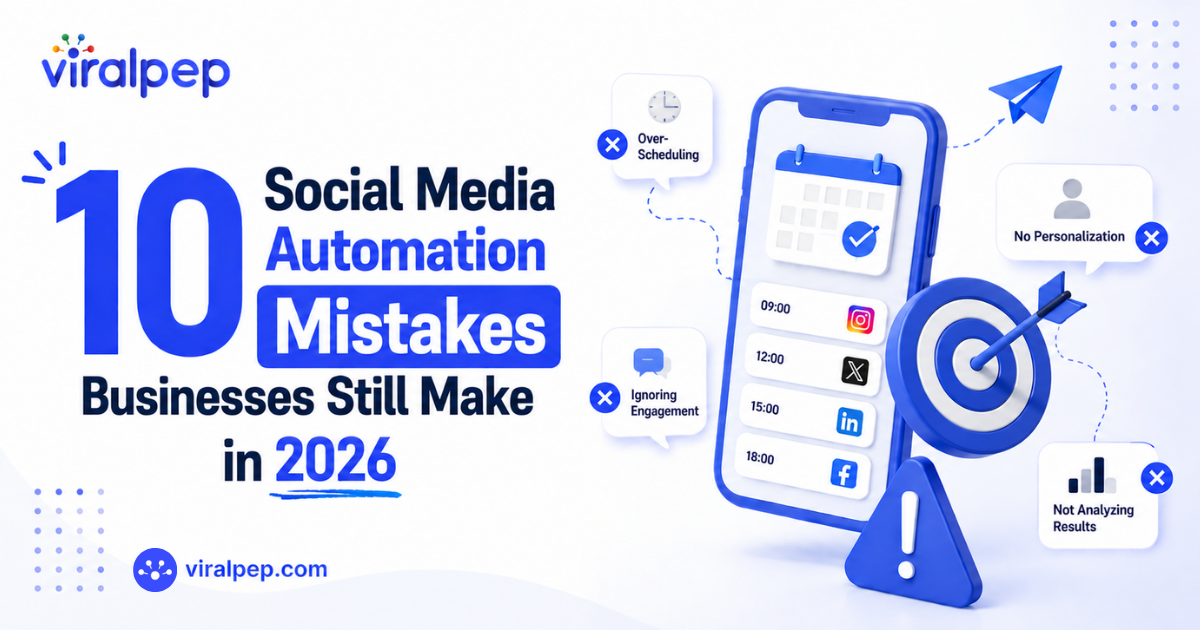
10 Social Media Automation Mistakes Businesses Still Make in 2026

Introduction

Social media automation has become an essential part of digital marketing in 2026. Businesses now rely on automation tools to schedule posts, manage multiple platforms, organize content calendars, monitor analytics, and maintain consistency across their social media presence.
As brands continue to publish more content across Instagram, Facebook, LinkedIn, X, Pinterest, and other platforms, manual social media management has become difficult to sustain. Automation helps businesses save time, improve workflow efficiency, and stay active online without managing every task manually.

However, many businesses still struggle to use automation effectively. Some brands rely too heavily on automated content and lose their brand personality. Others schedule content without reviewing performance data, audience behavior, or platform-specific strategies. In many cases, automation is being used to increase output without improving content quality or engagement.

Modern social media marketing requires a balance between automation, creativity, and real audience interaction. Businesses that use automation strategically are able to improve consistency while still maintaining authentic communication with their audience.

In this article, we’ll cover 10 social media automation mistakes businesses still make in 2026 and how to avoid them for better engagement, stronger branding, and more effective social media growth.

1. Automating Everything Without a Human Touch

Social media automation is designed to simplify repetitive tasks, not replace human interaction completely. Many businesses still make the mistake of automating every part of their social media presence, including captions, replies, comments, and direct messages, without adding any personal involvement.

While automation improves efficiency, excessive automation often makes content feel generic and disconnected from the audience. Users can easily recognize repetitive captions, templated replies, and robotic interactions. This reduces trust and weakens brand identity over time.

In 2026, audiences expect brands to communicate naturally and respond authentically. Social media platforms also continue prioritizing meaningful engagement, which means businesses that rely entirely on automation may struggle to maintain visibility and engagement rates.

Automated scheduling works best when paired with active community management. Businesses should still monitor comments, participate in conversations, respond thoughtfully to messages, and adapt content based on audience behavior and current trends.

Automation should handle repetitive workflows such as post scheduling, content organization, and publishing consistency. Brand voice, storytelling, and customer interaction should still involve human creativity and decision-making.

Businesses that successfully combine automation with authentic engagement are far more likely to build long-term audience trust and stronger social media communities.

2. Posting the Same Content Across Every Platform

One of the most common automation mistakes businesses still make in 2026 is publishing identical content across every social media platform without any customization. While cross-posting saves time, using the exact same caption, format, and creative on every platform often leads to weaker engagement.

Each social media platform attracts different audience behaviors and content preferences. A post that performs well on LinkedIn may not work effectively on Instagram. Similarly, short-form conversational content on X may feel out of place on Facebook or Pinterest.

Audiences also consume content differently depending on the platform. Instagram users typically prefer visually engaging and concise content, while LinkedIn audiences respond better to educational or professional insights. Pinterest focuses heavily on searchable visual content, while Facebook still favors community-driven engagement.

Businesses that automate content distribution without platform-specific optimization often miss opportunities to improve reach and engagement. Generic cross-posting can also make a brand appear less intentional and less connected to each audience segment.

A better approach is to use automation tools for scheduling and workflow management while customizing content for each platform. Small adjustments such as changing captions, hashtags, image formats, posting times, or call-to-actions can significantly improve performance.

In 2026, effective social media automation is not about publishing more content everywhere. It is about delivering the right content in the right format for the right audience on each platform.

3. Ignoring Analytics and Performance Data

Many businesses automate their social media publishing process but fail to regularly review performance data. Scheduling content without analyzing results often leads to repeated mistakes, declining engagement, and missed growth opportunities.

Automation makes it easier to maintain posting consistency, but consistency alone does not guarantee results. Businesses need to understand which content performs well, which platforms generate the most engagement, and what type of posts their audience actually responds to.

In 2026, social media algorithms continue evolving rapidly, making performance tracking more important than ever. Audience behavior, engagement patterns, and content trends can change quickly across platforms. Businesses that ignore analytics often continue publishing ineffective content simply because it is already scheduled and automated.

Key metrics such as engagement rate, reach, impressions, saves, shares, click-through rates, and audience growth provide valuable insight into content performance. Reviewing this data helps businesses refine their content strategy and improve future campaigns.

Analytics also help businesses identify the best posting times, strongest content formats, and highest-performing topics for each platform. Without these insights, automation becomes a repetitive publishing system instead of a growth strategy.

Businesses should regularly review their social media analytics and adjust their automation workflows accordingly. Automation works best when it is guided by real performance data instead of assumptions.

4. Scheduling Content Too Far in Advance

Scheduling content in advance helps businesses stay organized and maintain posting consistency. However, many brands still make the mistake of planning and automating large volumes of content too far ahead without leaving room for flexibility.

Social media trends move quickly in 2026. Audience interests, platform algorithms, industry news, and online conversations can shift within days. Content that felt relevant a month ago may no longer connect with audiences by the time it gets published.

Over-scheduling also increases the risk of posting outdated promotions, irrelevant messaging, or content that conflicts with current events. Businesses that automate months of content without regular reviews often struggle to maintain relevance and engagement.

Another common issue is missing opportunities to participate in trending conversations or timely topics. Brands with rigid automated schedules may find it difficult to react quickly to viral moments, seasonal trends, or audience feedback.

A smarter approach is to maintain a structured content calendar while leaving room for updates and real-time content adjustments. Businesses should regularly review scheduled posts, refresh outdated messaging, and keep space available for trend-driven or reactive content.

Automation should improve consistency without making content feel disconnected from what is currently happening online. Flexible scheduling allows businesses to stay organized while still remaining relevant and responsive.

5. Overusing AI-Generated Captions Without Editing

AI-generated content has become a major part of social media automation in 2026. Many businesses now use AI tools to create captions, generate ideas, write hashtags, and speed up content production. While AI can significantly improve efficiency, relying entirely on unedited AI-generated captions often creates repetitive and low-quality content.

One of the biggest problems with raw AI-generated content is the lack of brand personality. Captions generated without human editing often sound generic, overly formal, or similar to content used by countless other brands. Over time, this weakens brand identity and reduces audience connection.

AI-generated captions may also miss important context, platform-specific tone, or audience expectations. Some captions become unnecessarily long, filled with vague marketing language, or disconnected from the actual visual content being posted.

Businesses that use AI effectively typically treat it as a starting point rather than a final solution. Human editing helps refine tone, improve clarity, add personality, and ensure the content aligns with the brand voice.

In 2026, audiences value authenticity more than volume. Businesses that publish high quantities of generic AI-generated content often experience lower engagement compared to brands that prioritize relatable and well-edited messaging.

AI should support creativity and productivity, not replace thoughtful communication. Businesses that combine AI efficiency with human creativity are more likely to create content that feels engaging, relevant, and authentic.

6. Neglecting Real-Time Engagement

Automation can help businesses maintain a consistent posting schedule, but it cannot replace real-time audience interaction. Many brands still focus heavily on automated publishing while spending very little time engaging directly with their audience.

Social media platforms continue prioritizing active engagement in 2026. Responding to comments, participating in conversations, replying to direct messages, and interacting with trending discussions all contribute to stronger visibility and audience relationships.

Businesses that only publish automated content without engaging with their community often appear inactive or disconnected. Audiences are far more likely to trust and support brands that communicate naturally and respond consistently.

Real-time engagement also helps businesses better understand their audience preferences, feedback, and concerns. Comments and conversations often provide valuable insights that can improve future content strategies and customer experience.

Another major advantage of active engagement is improved brand loyalty. Quick responses, thoughtful replies, and genuine interaction help businesses build stronger relationships with their audience over time.

Automation should support content management and workflow efficiency, while human interaction should remain a core part of the social media strategy. Businesses that balance both are more likely to maintain healthy engagement and long-term audience growth.

7. Using Automation Without a Content Strategy

Many businesses invest in social media automation tools without building a clear content strategy first. While automation can improve efficiency, it cannot fix inconsistent messaging, unclear goals, or weak content planning.

A common mistake in 2026 is treating automation as the entire social media strategy instead of using it as a support system. Scheduling content regularly does not automatically lead to audience growth or better engagement if the content itself lacks direction and purpose.

Businesses often publish random promotional posts, inconsistent visuals, or unrelated topics simply to maintain activity. This creates a fragmented social media presence that makes it difficult for audiences to understand the brand identity or value.

A strong content strategy should define content pillars, target audience preferences, posting goals, platform priorities, and brand messaging. Businesses should also plan content based on specific objectives such as brand awareness, engagement, lead generation, or customer retention.

Automation becomes far more effective when it supports a structured strategy. Content calendars, scheduling workflows, and automated publishing should all align with broader marketing goals and audience expectations.

In 2026, successful social media marketing depends on consistency, relevance, and strategic planning. Businesses that combine automation with a clear content strategy are more likely to build stronger engagement and long-term brand growth.

8. Not Optimizing Posting Times

Posting time continues to play an important role in social media performance, even with the growth of automation tools and algorithm-driven feeds. Many businesses still schedule content without analyzing when their audience is actually most active online.

Different platforms attract different user behaviors and engagement patterns. A posting schedule that works well on Instagram may not perform effectively on LinkedIn, Facebook, or X. Audience activity can also vary depending on industry, location, and content type.

Businesses that ignore posting time optimization often experience lower reach and weaker engagement, even when the content quality is strong. Publishing content when the target audience is inactive reduces the chances of immediate interaction, which can negatively impact overall performance.

Modern automation tools make it easier to schedule content strategically based on audience insights and engagement trends. Reviewing analytics regularly helps businesses identify the best time windows for publishing content on each platform.

Another common mistake is using the same posting schedule throughout the year without adjusting for audience behavior changes. Seasonal trends, holidays, campaign periods, and shifting platform usage patterns can all influence optimal posting times.

In 2026, effective social media automation requires more than simply filling a content calendar. Businesses that combine scheduling automation with performance-driven timing strategies are more likely to maximize reach, engagement, and visibility.

9. Forgetting About Team Collaboration and Approval Workflows

As businesses grow, social media management often involves multiple team members handling content creation, design, scheduling, approvals, and reporting. Many brands still use automation tools without establishing proper collaboration and approval workflows, which can lead to avoidable mistakes and inconsistent communication.

Without a structured review process, businesses may publish content with incorrect information, inconsistent branding, design issues, or messaging that does not align with campaign goals. These problems become more common when several people manage multiple social media accounts simultaneously.

Approval workflows are especially important for social media management agencies, growing businesses, and larger marketing teams. Content often needs to be reviewed by managers, clients, designers, or legal teams before publication. Without organized collaboration, delays and miscommunication can disrupt the entire content schedule.

Modern social media automation tools now offer shared calendars, content approvals, role management, and collaborative publishing features that help teams stay aligned. These systems improve workflow efficiency while reducing the risk of publishing errors.

Strong collaboration also improves content quality. Teams that communicate effectively are better able to maintain consistent branding, coordinate campaigns, and respond quickly to feedback or content changes.

In 2026, social media automation is not only about scheduling posts efficiently. It is also about creating smoother workflows that allow teams to collaborate effectively while maintaining quality and consistency across every platform.

10. Choosing Complicated Tools That Slow Teams Down

Many businesses assume that using more features and more complex automation systems will automatically improve their social media performance. In reality, overly complicated tools often create confusion, slow down workflows, and reduce overall productivity.

In 2026, businesses manage content across multiple platforms, campaigns, and team members. When automation tools are difficult to navigate or require complicated processes for basic tasks, teams often spend more time managing the software than creating effective content.

Complex dashboards, disconnected workflows, excessive integrations, and difficult approval systems can create unnecessary friction in daily operations. This becomes especially challenging for small businesses, startups, and growing teams that need fast and efficient content management.

Another common issue is poor tool adoption within teams. If social media automation platforms are too technical or difficult to learn, team members may avoid using important features altogether. This leads to inconsistent workflows and reduced efficiency across the organization.

The most effective automation tools focus on simplicity, organization, and ease of use. Businesses benefit more from centralized scheduling, clear collaboration systems, streamlined analytics, and intuitive dashboards than from overly complicated feature lists.

Automation should reduce workload and improve efficiency, not create additional operational challenges. Businesses that choose user-friendly and scalable automation platforms are more likely to maintain consistent workflows and stronger long-term social media performance.

How to Use Social Media Automation the Right Way in 2026

Social media automation delivers the best results when it is used to support strategy, creativity, and consistency instead of replacing them entirely. Businesses that approach automation strategically are able to save time while still maintaining authentic audience engagement and high-quality content.

The most effective approach is to automate repetitive tasks such as scheduling posts, organizing content calendars, tracking analytics, and managing publishing workflows. This allows marketing teams to focus more on content quality, creative campaigns, and audience interaction.

Businesses should also regularly review performance data to improve their automation strategy over time. Analytics help identify what content performs best, when audiences are most active, and which platforms generate the strongest engagement.

Flexibility is equally important. Automated schedules should leave room for trend-based content, seasonal updates, and real-time engagement opportunities. Brands that remain adaptable are more likely to stay relevant in fast-changing social media environments.

Maintaining a strong brand voice is another critical factor. Even when using AI tools or automated workflows, content should still feel personal, intentional, and aligned with the brand identity.

In 2026, successful social media automation is built on balance. Businesses that combine automation with creativity, audience engagement, performance tracking, and strategic planning are more likely to build sustainable growth across their social media platforms.

Conclusion

Social media automation continues to be one of the most valuable tools for businesses in 2026. It helps brands save time, maintain consistency, manage multiple platforms efficiently, and streamline content workflows at scale.

However, automation alone does not guarantee strong engagement or long-term growth. Businesses that rely too heavily on automated publishing, generic AI-generated content, or rigid scheduling often struggle to maintain authenticity and audience connection.

The most successful brands use automation as a support system rather than a replacement for strategy and creativity. They combine scheduling tools with active engagement, data-driven decisions, platform-specific content, and strong brand communication.

Avoiding these common automation mistakes can help businesses improve content performance, strengthen audience relationships, and create more effective social media strategies overall.

With the right balance of automation, creativity, and flexibility, businesses can build a more organized and impactful social media presence in 2026 and beyond.

Frequently Asked Questions

Is social media automation still effective in 2026?

Yes, social media automation remains highly effective in 2026 when used strategically. Automation helps businesses save time, maintain consistent posting schedules, organize content workflows, and manage multiple social media platforms more efficiently. However, businesses still need to combine automation with authentic engagement, creative content, and performance analysis for the best results.

Can social media automation reduce engagement?

Social media automation can reduce engagement if businesses rely too heavily on generic automated content or avoid real audience interaction. Automated publishing without personalization, community engagement, or platform-specific optimization often leads to lower audience connection and weaker performance.

What should businesses automate on social media?

Businesses should automate repetitive tasks such as post scheduling, content calendars, publishing workflows, analytics tracking, and reporting. Creative storytelling, audience engagement, customer communication, and brand voice should still involve human input and oversight.

How often should automated social media content be reviewed?

Businesses should review automated content regularly to ensure it remains relevant, accurate, and aligned with current trends or audience behavior. Weekly or bi-weekly content reviews help prevent outdated messaging and improve content performance over time.

What are the biggest social media automation mistakes businesses make?

Some of the biggest mistakes include posting identical content across all platforms, ignoring analytics, overusing unedited AI-generated captions, scheduling content too far in advance, and neglecting real-time audience engagement. Businesses that balance automation with strategy and authenticity typically achieve better results.

Top 10 Social Media Marketing Challenges (And How Scheduled Content Solves Them)

Introduction

Social media marketing continues to evolve rapidly, and in 2026, brands face more pressure than ever to stay consistent, engaging, and competitive across multiple platforms. Businesses are no longer competing only for visibility — they are competing for attention, authenticity, and meaningful engagement. While platforms like Instagram, LinkedIn, TikTok, and Facebook offer huge marketing potential, managing them efficiently has become increasingly complex.
Many brands struggle with Social Media Marketing challenges such as inconsistent posting, declining engagement, content burnout, and difficulty managing multiple client accounts. These challenges not only impact brand visibility but also affect long-term marketing ROI and audience trust.

Modern marketers are now turning to automation and scheduling strategies to maintain consistency and improve performance. Platforms like Viralpep’s social media management solution help businesses streamline publishing workflows and manage multiple accounts efficiently. You can explore more social media strategies and insights on the Viralpep blog:

In this article, we will explore the most critical Social Media Marketing challenges businesses face in 2026 and how scheduled content provides effective, scalable solutions.

Why Social Media Marketing Challenges Are Increasing in 2026

Social media platforms are constantly changing algorithms, introducing new formats, and increasing competition. According to industry research by HubSpot, brands must now publish consistent, personalized, and data-driven content to maintain visibility.

The increasing complexity of digital marketing makes it difficult for brands to stay organized, especially when managing multiple campaigns and platforms simultaneously. Scheduled content has emerged as one of the most effective solutions to overcome these challenges.

Social Media Marketing Challenges

1. Inconsistent Posting Frequency

The Challenge

One of the biggest Social Media Marketing challenges brands face is maintaining a consistent posting schedule. Many businesses post actively during campaign launches but become inactive afterward. Inconsistent posting reduces visibility and signals poor brand reliability to audiences.

Social media algorithms favor brands that post regularly. When posting becomes irregular, reach and engagement naturally decline.

How Scheduled Content Solves It

Scheduled social media content ensures posts are published consistently, even during busy business periods. Automation tools allow marketers to prepare content in advance and maintain posting frequency across all platforms.

Scheduled content allows brands to:

  • Maintain regular posting cadence
  • Avoid last-minute content stress
  • Improve algorithm visibility
  • Build audience expectations and trust

Businesses can use automation tools like Viralpep’s scheduler to manage consistent publishing across channels.

2. Managing Multiple Client or Brand Accounts

The Challenge

Agencies and growing businesses often manage multiple social media profiles simultaneously. Tracking posting schedules, engagement, and analytics across various accounts is one of the most demanding Social Media Marketing challenges today.

Without proper planning, teams experience workflow confusion and missed posting opportunities.

How Scheduled Content Solves It

Scheduled social media content allows agencies to manage multiple accounts through centralized dashboards. Teams can organize content calendars, assign tasks, and track publishing timelines efficiently.

Automation also helps reduce human errors and ensures clients receive consistent campaign delivery.

Platforms such as Sprout Social emphasize centralized scheduling as an effective approach for simplifying multi-account management.

3. Content Creation Burnout

The Challenge

Creating high-quality content daily is exhausting for marketing teams. Content fatigue is becoming one of the most common Social Media Marketing challenges, especially with rising demands for video, carousel posts, and interactive formats.

Marketers often struggle to maintain creativity while meeting tight deadlines.

How Scheduled Content Solves It

Scheduled content allows marketers to batch create posts during creative brainstorming sessions. Instead of daily content pressure, teams can design weekly or monthly campaigns in advance.

Benefits include:

  • Better content quality
  • Reduced stress and burnout
  • More strategic campaign planning
  • Stronger brand storytelling

Content batching also allows teams to align marketing themes with seasonal campaigns and product launches.

4. Difficulty Tracking Performance Metrics

The Challenge

Many brands struggle to track and analyze social media performance effectively. Without data insights, marketing teams cannot measure ROI or optimize campaigns. This is a major Social Media Marketing challenge affecting growth.

Marketers must monitor engagement rates, reach, impressions, and conversion data to improve results.

How Scheduled Content Solves It

Scheduled social media content tools often include built-in analytics dashboards. These tools track campaign performance automatically and provide actionable insights.

According to Statista, businesses using automation tools see improved campaign performance and data accuracy

Automation tools help marketers:

  • Identify top-performing content
  • Adjust posting time strategies
  • Optimize audience targeting
  • Improve long-term ROI

5. Managing Multiple Platform Algorithms

The Challenge

Each social media platform uses different algorithms and content ranking factors. Adapting content strategies for Instagram, LinkedIn, Facebook, and TikTok is a significant Social Media Marketing challenge.

Platform updates require constant monitoring and adaptation.

How Scheduled Content Solves It

Scheduled social media content allows marketers to customize posts for each platform while maintaining unified campaign messaging.

Advanced scheduling tools provide platform-specific optimization features such as:

  • Recommended posting times
  • Content format adjustments
  • Hashtag performance insights
  • Audience engagement tracking

This ensures brands stay relevant across all platforms.

6. Time Zone and Audience Timing Issues

The Challenge

Global businesses often struggle with posting content at the right time for international audiences. Posting at incorrect times reduces visibility and engagement, making it one of the overlooked Social Media Marketing challenges.

How Scheduled Content Solves It

Automation tools allow brands to schedule posts according to audience time zones. This ensures content reaches users when they are most active.

Scheduled posting improves:

  • Engagement rates
  • Content reach
  • Audience retention
  • Campaign effectiveness

7. Lack of Content Strategy Planning

The Challenge

Many businesses publish random content without long-term planning. Lack of structured content strategy is one of the major Social Media Marketing challenges that affects brand positioning.

Without strategic planning, brands struggle to deliver consistent messaging.

How Scheduled Content Solves It

Scheduled social media content encourages structured content calendars. Marketing teams can plan campaigns based on business goals, seasonal promotions, and audience interests.

To build strong content strategies, businesses can follow structured social media planning techniques.

Content calendars help brands maintain balanced content formats including educational, promotional, and engagement-focused posts.

8. Difficulty Maintaining Brand Voice Consistency

The Challenge

When multiple team members manage social media, maintaining consistent brand tone becomes difficult. This inconsistency creates confusion among audiences and weakens brand identity.

Brand voice inconsistency is becoming a major Social Media Marketing challenge for growing businesses.

How Scheduled Content Solves It

Scheduled content allows teams to review posts before publishing. This ensures messaging aligns with brand tone and marketing objectives.

Content approval workflows help businesses maintain professional and unified communication across platforms, and team management tools like Viralpep make this process smoother by enabling teams to collaborate, review, and approve content efficiently before publishing.

9. Managing Campaign Deadlines and Promotions

The Challenge

Marketing campaigns require precise scheduling for product launches, events, and promotional offers. Missing deadlines is a costly Social Media Marketing Challenges that impacts revenue opportunities.

How Scheduled Content Solves It

Scheduled social media content helps marketers plan promotional campaigns in advance. Teams can prepare entire campaign series before launch dates.

Scheduling helps brands:

  • Maintain campaign consistency
  • Avoid last-minute publishing errors
  • Coordinate cross-platform promotions
  • Improve campaign timing accuracy

Businesses can streamline promotional scheduling and automate marketing campaigns more effectively with the advanced features offered by Viralpep, allowing teams to plan, execute, and optimize campaigns while maintaining consistent brand communication across multiple platforms.

10. Limited Team Productivity and Workflow Efficiency

The Challenge

Manual content publishing consumes valuable marketing time. Teams spend hours switching between platforms, reducing overall productivity. This is one of the most operational Social Media Marketing challenges companies face today.

How Scheduled Content Solves It

Automation improves marketing efficiency by reducing manual workload. Scheduled social media content allows teams to focus on creative strategy, audience engagement, and campaign optimization.

According to Gartner marketing research, automation significantly improves productivity and marketing ROI.

Automation tools help streamline marketing workflows and enhance collaboration among team members.

Best Practices for Implementing Scheduled Social Media Content

To overcome Social Media Marketing challenges, businesses should follow these scheduling best practices:

Create Monthly Content Calendars

Planning content monthly improves campaign consistency and marketing alignment.

Use Data-Driven Posting Strategies

Analyze audience behavior to schedule posts during peak engagement times.

Maintain Content Variety

Include educational, promotional, and interactive content formats.

Monitor Performance Analytics

Regular performance reviews help improve scheduling strategies.

Use Professional Scheduling Tools

Reliable automation platforms simplify content management and improve results.

Future Trends in Scheduled Social Media Content

Scheduled social media content is evolving with AI-driven optimization, predictive analytics, and personalized automation. Future tools will provide smarter scheduling recommendations based on audience behavior and real-time performance data.

Businesses adopting automation early will gain competitive advantages in social media marketing performance and customer engagement.

Conclusion

The digital marketing landscape in 2026 presents multiple Social Media Marketing Challenges that businesses cannot ignore. From inconsistent posting and content burnout to algorithm complexity and workflow inefficiencies, managing social media successfully requires strategic planning and advanced automation.

Scheduled social media content provides a powerful solution to these challenges by improving consistency, enhancing productivity, and delivering data-driven marketing performance. Businesses that adopt scheduling tools can focus more on creativity, engagement, and growth rather than manual publishing tasks.

If you want to simplify your social media workflow and improve marketing results, explore the advanced automation solutions offered by Viralpep. You can start with a free trial to experience its powerful scheduling, collaboration, and automation features firsthand. To unlock full capabilities, including advanced campaign management and team workflow tools, you can also explore the platform’s pricing page to find a plan that best fits your business needs.

Frequently Asked Questions (FAQs)

What are the biggest social media marketing challenges businesses face in 2026?

The biggest challenges include maintaining consistent posting schedules, managing multiple social media platforms, tracking performance metrics, adapting to changing algorithms, and preventing content creation burnout. Businesses also struggle with managing approval workflows, maintaining brand voice consistency, and scheduling content for global audiences. These challenges can reduce engagement, limit reach, and negatively impact marketing ROI if not managed strategically.

How does scheduled content help solve social media marketing challenges?

Scheduled content allows businesses to plan, create, and automate social media posts in advance. This helps maintain consistent posting frequency, reduces manual workload, and ensures campaigns are published at optimal times. Scheduling also improves workflow organization, enhances content quality through better planning, and provides analytics insights that help marketers optimize performance.

Why is consistency important in social media marketing?

Consistency helps brands stay visible to their audience and maintain trust. Social media algorithms prioritize accounts that publish regularly and engage consistently with users. When brands post inconsistently, engagement rates often decline, and audience interest may drop. Scheduled content ensures brands maintain regular posting schedules without daily manual effort.

Can social media scheduling tools improve marketing productivity?

Yes, scheduling tools significantly improve productivity by automating repetitive publishing tasks. Instead of manually posting content across multiple platforms, marketers can manage campaigns from a single dashboard. Advanced tools like Viralpep allow teams to automate posting, manage multiple client accounts, collaborate on content approval, and track performance metrics efficiently.

How far in advance should businesses schedule social media content?

Most marketing experts recommend scheduling content at least 2–4 weeks in advance. This allows businesses to plan campaigns strategically, maintain content consistency, and adjust posts based on performance insights. Larger campaigns, seasonal promotions, and product launches may require even longer planning timelines.

Does scheduled content reduce content quality or audience engagement?

No, scheduled content actually improves content quality when implemented correctly. Scheduling allows marketers to batch create posts during creative planning sessions, resulting in more thoughtful and engaging content. It also helps brands post during peak audience activity times, which can increase engagement and reach.

Are scheduling tools suitable for agencies managing multiple clients?

Yes, scheduling tools are especially beneficial for agencies handling multiple client accounts. They help agencies organize content calendars, assign tasks to team members, track campaign deadlines, and streamline approval workflows. This reduces confusion, improves client communication, and ensures consistent campaign delivery.

Social Media Management for Agencies: 10 Proven Tips

Introduction:

Managing social media for a single brand is already challenging, but agencies handling multiple clients face an entirely different level of complexity. From juggling different brand voices and posting schedules to tracking performance metrics across various platforms, the pressure on agencies continues to grow in 2026. With social media algorithms evolving rapidly and audience expectations becoming more personalized, agencies must adopt smarter workflows and automation tools to stay competitive.
Many marketing agencies are now shifting toward centralized management platforms and streamlined processes to reduce errors, save time, and improve campaign performance. Platforms like Viralpep help agencies automate publishing, manage multiple accounts, and monitor performance from one dashboard, making client handling significantly easier and more efficient.

Why Social Media Management is Becoming More Complex in 2026

According to recent industry research published by HubSpot, businesses are increasing their investment in multi-platform social strategies and personalized content marketing, which directly increases the workload for agencies.

Additionally, research from Sprout Social highlights that brands now expect real-time engagement, detailed analytics, and customized content strategies for every campaign.

These expectations make social media management for agencies more demanding than ever before. Without structured systems and automation, agencies risk missed deadlines, inconsistent branding, and reduced client satisfaction.

Social Media Management

1. Create a Standardized Client Onboarding Process

Why It Matters

Managing multiple clients without a structured onboarding process often leads to confusion, unclear expectations, and repeated revisions. When agencies begin working with new clients without collecting essential brand details, teams may create content that does not align with the client’s goals, tone, or audience preferences. This misalignment can waste valuable time, delay campaigns, and reduce client satisfaction.

A standardized onboarding system ensures every project starts with clear direction, reducing guesswork and improving workflow efficiency. It also helps teams maintain consistency when handling multiple client accounts simultaneously.

Best Practices

To create a successful onboarding process, agencies should focus on collecting and organizing key information from the beginning. Important steps include:

  • Gathering detailed brand guidelines, including brand voice, visual identity, and messaging style
  • Identifying the client’s target audience and ideal customer profiles
  • Defining content tone, communication goals, and campaign objectives
  • Confirming posting frequency and preferred social media platforms
  • Establishing approval workflows to streamline content review and publishing

Using structured onboarding checklists or automated onboarding forms can further improve efficiency and reduce manual errors.

Real-Life Problem Solved

Many agencies face challenges when clients request multiple content revisions because initial expectations were not clearly defined. For example, an agency managing social media campaigns for a retail brand may publish promotional content that does not match the client’s brand personality. This leads to delays, repeated revisions, and strained communication.

By implementing a standardized onboarding process, agencies can ensure all stakeholders share the same understanding from the start. This reduces revision cycles, speeds up campaign launches, and strengthens long-term client relationships.

2. Use a Centralized Social Media Management Platform

Managing dozens of client accounts across different platforms manually is nearly impossible in 2026.

Using tools designed for managing multiple social media clients workflows allows agencies to schedule posts, monitor engagement, and generate reports from one place.

Platforms like Viralpep Social Media Management Tool allow agencies to:

  • Schedule content across multiple platforms
  • Manage multiple client dashboards
  • Automate publishing
  • Track campaign performance
  • Reduce manual workload

Real-Life Problem Solved

Agencies often waste hours switching between social platforms. Centralized tools reduce time and prevent posting errors.

3. Build a Content Calendar for Every Client

A well-organized content calendar ensures consistent posting and campaign alignment.

What to Include in Client Calendars

  • Posting schedule
  • Campaign themes
  • Promotional events
  • Seasonal campaigns
  • Content approval deadlines

Pro Tip

Use color coding for different clients to avoid scheduling conflicts.

Real-Life Problem Solved

Agencies frequently miss posting deadlines when managing multiple accounts simultaneously. A content calendar eliminates confusion and improves efficiency.

4. Automate Repetitive Social Media Tasks

Automation has become essential for social media workflow automation in modern agencies.

Tasks You Can Automate

  • Post scheduling
  • Content recycling
  • Performance reporting
  • Audience engagement tracking

According to Hootsuite, agencies using automation tools improve productivity by up to 40%.

Real-Life Problem Solved

Manual posting increases human error and consumes valuable time. Automation allows agencies to focus more on creative strategy.

5. Maintain Separate Brand Voice Guidelines for Each Client

Every client has unique branding, messaging style, and target audience. Mixing brand tones can damage credibility.

How to Maintain Brand Consistency

  • Document brand tone and style
  • Maintain content examples
  • Create caption writing guidelines
  • Store client messaging preferences

Real-Life Problem Solved

Agencies handling multiple clients often struggle with tone consistency. Proper brand documentation prevents content confusion.

6. Use Data Analytics to Optimize Campaign Performance

Successful social media management for agencies depends heavily on data-driven decision making.

Metrics Agencies Should Track

  • Engagement rate
  • Audience growth
  • Conversion rate
  • Click-through rate
  • Content performance trends

Research from Social Media Examiner shows that agencies using performance analytics consistently outperform competitors.

Real-Life Problem Solved

Agencies sometimes rely on assumptions instead of data. Analytics helps agencies prove ROI and improve client retention.

7. Implement Structured Team Collaboration Workflows

When multiple team members handle multiple clients, communication gaps can lead to publishing errors.

Effective Collaboration Methods

  • Assign client managers
  • Use shared dashboards
  • Implement approval systems
  • Maintain internal communication tools

Real-Life Problem Solved

Agencies frequently face duplicate posting or missed approvals. Structured collaboration prevents workflow breakdowns.

8. Prioritize Platform-Specific Content Strategies

Posting the same content across all platforms is no longer effective in 2026.

Platform Optimization Examples

  • Instagram: Visual storytelling and reels
  • LinkedIn: Professional and educational content
  • Twitter (X): Real-time engagement and industry updates
  • Facebook: Community engagement and ads

Real-Life Problem Solved

Agencies often lose engagement due to identical cross-platform content. Custom platform strategies improve audience connection.

9. Create Scalable Reporting Systems for Clients

Clients expect transparent and detailed performance reports.

What Clients Want in Reports

  • Campaign performance metrics
  • Audience growth statistics
  • Content engagement analysis
  • Strategy improvement recommendations

Automated reporting tools allow agencies to generate professional reports without manual effort.

Real-Life Problem Solved

Manual reporting is time-consuming and prone to errors. Automated reporting improves client trust and saves agency resources.

10. Stay Updated With Social Media Trends and Algorithm Changes

Social media trends evolve rapidly. Agencies must stay informed to maintain competitive advantage.

Ways to Stay Updated

  • Follow industry research
  • Monitor competitor strategies
  • Attend marketing webinars
  • Analyze platform algorithm updates

Real-Life Problem Solved

Agencies relying on outdated strategies lose engagement. Continuous learning helps agencies maintain strong campaign performance.

Conclusion

Managing multiple social media clients requires more than creativity – it demands organization, automation, and data-driven strategy. Agencies that adopt structured onboarding processes, centralized management platforms, automated workflows, and performance analytics consistently deliver better results and maintain long-term client relationships.

By following these practical social media management strategies, agencies can streamline daily operations, enhance campaign results, and expand their client services more effectively.Agencies looking to scale their social media operations efficiently can significantly benefit from using advanced management platforms like Viralpep. The platform helps agencies centralize client account management, automate publishing schedules, streamline team collaboration, and monitor performance analytics from a single dashboard. This not only reduces manual workload but also ensures consistent content delivery, improved campaign performance, and stronger client satisfaction. Agencies aiming to handle multiple clients without increasing operational complexity can explore Viralpep’s powerful automation features and flexible plans by visiting the social media management pricing planswhich are specifically designed to support growing agencies and marketing teams.

Frequently Asked Questions (FAQs)

What is the biggest challenge agencies face when managing multiple social media clients?

The biggest challenge agencies face is maintaining consistency across multiple client accounts while meeting different branding requirements, posting schedules, and performance expectations. Without structured workflows and centralized management systems, agencies often experience communication gaps, missed deadlines, and inconsistent campaign results.

Why is a standardized client onboarding process important for agencies?

A standardized onboarding process helps agencies clearly understand each client’s brand voice, target audience, campaign goals, and content preferences. This reduces confusion, minimizes content revisions, and ensures smoother campaign execution. Proper onboarding also helps agencies maintain long-term client relationships by delivering consistent results from the beginning.

How can agencies manage multiple social media accounts efficiently?

Agencies can manage multiple accounts efficiently by using centralized social media management platforms, creating structured content calendars, automating repetitive tasks, and implementing approval workflows. Tools like Viralpep allow agencies to schedule posts, monitor engagement, track performance metrics, and manage multiple client dashboards from one location.

Why should agencies use content calendars for social media management?

Content calendars help agencies organize posting schedules, plan marketing campaigns, align promotional strategies, and track approval deadlines. They improve workflow organization and ensure consistent content publishing across all client accounts, reducing last-minute content stress and scheduling conflicts.

How does social media automation benefit marketing agencies?

Automation reduces manual workload by handling tasks such as post scheduling, performance reporting, and audience engagement tracking. This allows agencies to focus on creative strategy, campaign optimization, and client communication while improving overall productivity and reducing human errors.

Why is maintaining brand voice consistency important for agencies?

Each client has a unique brand identity, messaging style, and communication tone. Inconsistent brand voice can confuse audiences and weaken brand credibility. Agencies should maintain detailed brand guidelines, content examples, and caption frameworks to ensure messaging consistency across all platforms.

What social media metrics should agencies track for client campaigns?

Agencies should track key performance indicators such as engagement rate, audience growth rate, conversion rate, click-through rate, and overall campaign ROI. Monitoring these metrics helps agencies evaluate campaign effectiveness, improve marketing strategies, and demonstrate measurable value to clients.

How can agencies improve collaboration between team members when managing multiple clients?

Agencies can improve collaboration by assigning dedicated client managers, using shared dashboards, implementing content approval workflows, and using internal communication tools. Structured collaboration helps prevent duplicate posting, missed approvals, and workflow confusion.

Why is platform-specific content important in modern social media marketing?

Each social media platform has different audience behavior patterns and content preferences. For example, Instagram prioritizes visual storytelling, LinkedIn focuses on professional content, and TikTok emphasizes short-form video engagement. Creating platform-specific content improves audience connection and campaign performance.

How can agencies create scalable reporting systems for clients?

Agencies can create scalable reporting systems by using automated analytics dashboards that generate performance reports regularly. These reports should include engagement metrics, audience growth data, campaign insights, and strategic recommendations. Automated reporting improves transparency and builds client trust.

How often should agencies review client social media performance?

Agencies should review campaign performance weekly for optimization and monthly for strategic evaluation. Regular performance analysis helps identify growth opportunities, adjust marketing strategies, and maintain consistent campaign improvement.

Agencies should regularly follow industry research, attend marketing webinars, monitor competitor strategies, and analyze platform update announcements. Staying informed helps agencies adapt quickly to algorithm changes and maintain strong marketing performance.

The Definitive Guide to the Best Amazon Affiliate WordPress Plugins (Tested & Ranked)

Introduction & Quick Verdict: The Top 5 Tools to Increase Amazon Commissions

The landscape of affiliate marketing WordPress tools is fierce, and to truly succeed today, you can’t rely on manual processes. The difference between a struggling affiliate site and a seven-figure machine is often a single, powerful piece of software: the best Amazon affiliate WordPress plugin. This tool transforms simple text links into high-converting, dynamic displays, handles mandatory Amazon API integration, and ensures compliance with ever-changing TOS.
AAWP

  • Core Strength: Automation, Conversion & Compliance
  • Price: $299 Lifetime
  • Geo-Targeting: Yes
  • Comparison Tables: Yes
  • API Required: Yes
  • Verdict: Our top pick for serious affiliates. It’s the ultimate Amazon Associates compliant plugin for power and customization.

Check AAWP Price & Trial Now

Lasso

  • Core Strength: Link Management & Optimization
  • Price: Freemium (starts at $4/mo to $24/mo)
  • Geo-Targeting: Yes
  • Comparison Tables: Limited
  • API Required: No (but supports API)
  • Verdict: Best for Affiliate Link Management and finding new revenue opportunities in existing content.

See Lasso Features

AzonPress

  • Core Strength: Ease of Use & Presentation
  • Price: Starts at $1.91/mo
  • Geo-Targeting: Yes
  • Comparison Tables: Yes
  • API Required: Yes
  • Verdict: Competes closely with AAWP, especially for beginners focused on beautiful product comparison tables.

Get Pricing here

ThirstyAffiliates

  • Core Strength: Cloaking & CTR Tracking
  • Price: Starts at $99.60 Yearly
  • Geo-Targeting: No
  • Comparison Tables: No
  • API Required: No
  • Verdict: Best for Affiliate Link Cloaking and management across all networks (not just Amazon).

ThirstyAffiliates Pricing

WZone

  • Core Strength: WooCommerce Integration
  • Price: $49 Lifetime
  • Geo-Targeting: Yes
  • Comparison Tables: Limited
  • API Required: Yes
  • Verdict: Excellent choice if you use WooCommerce Amazon Affiliates for dropshipping or virtual products.

WZone Plugin

Based on our rigorous testing, AAWP stands out as the definitive best Amazon Affiliate WordPress plugin, particularly for those serious about maximizing Amazon affiliate earnings via automated content displays.

The Definitive Comparison Table: How the Top 5 Plugins Stack Up

Top 5 Plugins

The difference in commission rates often comes down to advanced, revenue-driving features. This detailed list breaks down the essential factors needed to select the best Amazon Affiliate WordPress plugin for your needs.

AAWP

AAWP

  • Core Value: Automation & CRO
  • Amazon API Integration: Required
  • Automatic Price Updates: Yes
  • Geo-Targeting: Yes (Premium)
  • Product Comparison Tables: Advanced
  • Affiliate Link Cloaking: Built-in
  • Bestseller Lists Generation: Yes
  • Custom Amazon Product Boxes: Yes (Templates)
  • Affiliate Link Tracking: Basic Clicks
  • Gutenberg Amazon Affiliate Blocks: Yes
  • TOS Compliance Focus: High
  • Auto-Link Keywords: Yes

Lasso

Lasso

  • Core Value: Link Centralization
  • Amazon API Integration: Optional/Supported
  • Automatic Price Updates: Yes
  • Geo-Targeting: Yes (Premium)
  • Product Comparison Tables: Limited (Display Boxes)
  • Affiliate Link Cloaking: Core Feature
  • Bestseller Lists Generation: No
  • Custom Amazon Product Boxes: Yes (Display Boxes)
  • Affiliate Link Tracking: Advanced (Monetization)
  • Gutenberg Amazon Affiliate Blocks: Yes
  • TOS Compliance Focus: High
  • Auto-Link Keywords: Yes

AzonPress

AzonPress

  • Core Value: Design & Display
  • Amazon API Integration: Required
  • Automatic Price Updates: Yes
  • Geo-Targeting: Yes (Premium)
  • Product Comparison Tables: Advanced
  • Affiliate Link Cloaking: Built-in
  • Bestseller Lists Generation: Yes
  • Custom Amazon Product Boxes: Yes (Templates)
  • Affiliate Link Tracking: Basic Clicks
  • Gutenberg Amazon Affiliate Blocks: Yes
  • TOS Compliance Focus: High
  • Auto-Link Keywords: No

ThirstyAffiliates

ThirstyAffiliates

  • Core Value: Link Organization
  • Amazon API Integration: No
  • Automatic Price Updates: No
  • Geo-Targeting: No
  • Product Comparison Tables: No
  • Affiliate Link Cloaking: Core Feature
  • Bestseller Lists Generation: No
  • Custom Amazon Product Boxes: No
  • Affiliate Link Tracking: Advanced (Pro)
  • Gutenberg Amazon Affiliate Blocks: No
  • TOS Compliance Focus: Low (General)
  • Auto-Link Keywords: Yes

WZone

WZone

  • Core Value: WooCommerce Integration
  • Amazon API Integration: Required
  • Automatic Price Updates: Yes
  • Geo-Targeting: Yes
  • Product Comparison Tables: No
  • Affiliate Link Cloaking: Built-in
  • Bestseller Lists Generation: No
  • Custom Amazon Product Boxes: Yes
  • Affiliate Link Tracking: Sales Data
  • Gutenberg Amazon Affiliate Blocks: No
  • TOS Compliance Focus: High
  • Auto-Link Keywords: No

In-Depth Reviews (Tier 1 – Premium)

The Ultimate Tool for Automated Affiliate Linking and Conversion

AAWP Review: The Ultimate Tool for Automated Affiliate Linking and Conversion

AAWP (Amazon Affiliate WordPress Plugin) is the unchallenged heavyweight champion for serious Amazon affiliates. Its reputation as the best Amazon Affiliate WordPress plugin is rooted in its ability to generate dynamic, high-converting content with minimal effort. If your goal is to have the most reliable Amazon Associates compliant plugin that offers maximum customization, this is your tool.

Key Features and Why They Matter:

  1. Dynamic Data: Using the Amazon API integration, AAWP instantly pulls titles, images, and, most critically, automatic price updates. This is non-negotiable for TOS compliance and building visitor trust.
  2. Four Conversion-Focused Display Types: You can deploy powerful A-B tested formats: clean Product Boxes, high-conversion Bestseller Lists (dynamic top 10 lists for any category), detailed Product Comparison Tables, and simple text links.
  3. Shortcode Flexibility: The plugin uses simple shortcodes, meaning you can inject the same product box into a page, a post, or even a custom widget effortlessly. It also offers dedicated Gutenberg Amazon affiliate blocks for modern editing.
  4. Auto-Link Keywords: This feature is gold for passively generating revenue. It automatically converts specific keywords in your content (e.g., “best coffee maker”) into an affiliate link to the relevant Amazon product. This is true automated affiliate linking.

Pros: Unmatched flexibility in design; perfect Amazon Associates compliant plugin; highly reliable API for price updates; powerful geo-targeting feature.

Cons: Requires an Amazon API key (which can be a hurdle for brand new Associates accounts).

Best Use Case: Large niche sites, established bloggers, and any affiliate focused on high conversion rates and high-volume content.

Boost Affiliate Revenue Now: Start your 15-day trial and see why AAWP is the Best Amazon Affiliate WordPress Plugin.

Advanced Features Deep Dive: The Secrets to Boost Affiliate Revenue

To increase Amazon commissions, you must deploy advanced features that go beyond basic text links. The best Amazon Affiliate WordPress plugin makes these powerful tools accessible via simple shortcodes or Gutenberg Amazon affiliate blocks.

Maximizing Global Revenue with Geo-Targeting

Is your traffic 100% from the US? Probably not. If a user from the UK clicks an Amazon US link, you earn zero. Geo-targeting automatically detects the user’s location and redirects them to their nearest local Amazon storefront (e.g., Amazon.co.uk or Amazon.ca), ensuring you get the commission from their purchase.

Expert Tip: Plugins like AAWP (the best Amazon Affiliate WordPress plugin) and Lasso offer robust geo-targeting. Implementing this is the single fastest way to boost affiliate revenue from international visitors—often resulting in a 10%-20% lift in global earnings.

The Conversion Power of Product Comparison Tables

Users who are ready to buy often skip paragraphs and head straight for the table. The ability to create dynamic, mobile-friendly product comparison tables is the single most important CRO feature. The best Amazon Affiliate WordPress plugin allows you to dynamically populate these tables with:

  • Up-to-date pricing (automatic price updates).
  • Current review ratings.
  • Custom pros/cons cells.
  • High-contrast CTA buttons.

This feature is why AAWP dominates the market for product review sites.

The Non-Negotiable: Automatic Price Updates and API Compliance

The Non-Negotiable: Automatic Price Updates and API Compliance

Amazon strictly forbids manual, outdated pricing. If your price is wrong, you risk suspension, making an Amazon Associates compliant plugin essential.

The best Amazon Affiliate WordPress plugin utilizes a stable Amazon API integration to ensure your prices, stock, and descriptions are updated hourly (or more frequently, depending on the plugin’s caching), thereby saving you time and keeping your account safe. This is the core function of an automated affiliate linking system.

Essential Compliance and Management

The TOS Shield: Being an Amazon Associates Compliant Plugin

For any WordPress plugin for Amazon associates, compliance is the foundation. The key rules are:

  1. Price Accuracy: Managed via automatic price updates through the API.
  2. Disclosure: Clearly stating your use of affiliate links.
  3. Link Cloaking: Amazon requires that the actual amazon.com or amzn.to link be visible when the user hovers over it. The best Amazon Affiliate WordPress plugin handles this “semi-cloaking” correctly, unlike generic tools that might hide the domain completely.

Centralized Affiliate Link Tracking and Cloaking

While Amazon-specific tools are great, you still need to manage other links. Tools like Pretty Links for affiliate marketing and the premium version of ThirstyAffiliates for Amazon specialize in affiliate link cloaking by transforming long URLs into clean, brandable links (e.g., yoursite.com/go/product). Lasso excels by centralizing all of these links, offering superior affiliate link tracking and management for both Amazon and non-Amazon programs.

If you are using WooCommerce Amazon Affiliates (like WZone), the sales data is typically tracked via WooCommerce itself, adding another layer of complexity that advanced plugins simplify.

Final Verdict and Recommendation

After comparing everything from link tracking to API stability, the verdict is clear: The best Amazon Affiliate WordPress plugin for affiliates focused on scale, CTR, and long-term earnings is AAWP.

AAWP’s seamless integration of the most critical revenue-driving features—Amazon API integration, dynamic content, geo-targeting, and product comparison tables—provides the ultimate foundation to maximize Amazon affiliate earnings while remaining an Amazon Associates compliant plugin. The price is an investment, but it pays for itself quickly by generating reliable, automated commissions.

Our Final Recommendation for the Best Amazon Affiliate WordPress Plugin:

Overall Best & Most Powerful

  • Recommended Plugin: AAWP
  • Reason: Unmatched automation, CRO features, and full TOS compliance. This is the true Best Amazon Affiliate WordPress Plugin.

👉 Get AAWP Now

Best Link Management

  • Recommended Plugin: Lasso
  • Reason: Ideal for affiliate link tracking and monetizing existing content across multiple networks.

Best Budget & Tables

  • Recommended Plugin: AzonPress
  • Reason: The top choice for quick and beautiful product comparison tables for the budget-conscious.

This gives a clear, actionable list with direct links for quick decisions and plugin access.

How to Avoid Social Media Blocks and Stay Active

In the modern global environment, a well-developed social media presence has become a key factor in both personal branding and business expansion. Nonetheless, online engagement is becoming an uphill task. It’s not uncommon for apps to limit or prohibit people’s activities out of the blue. Maintaining an uninterrupted social media presence is therefore paramount for sustained influence. This article aims to arm you with smart habits to navigate the complexities of social media.
What Are Social Media Blocks?

Social media blocks are a platform’s way of putting you in a digital timeout, limiting or completely halting your activity. They’re applied for a variety of reasons, acting as digital bouncers to keep the online party civil and safe. You may end up on the naughty list for going against the community’s rules. The platforms also monitor any suspicious behavior, including farming followers through bot usage. Copyright infringement is another quick way to get your account frozen. Lastly, your IP address can also get flagged if it’s associated with previous misbehavior.

Temporary blocks restrict certain features, such as commenting for a set period. These are usually for minor infractions. Then, there are permanent bans that are reserved for serious violations. Finally, the mysterious shadow banning occurs when your content becomes practically invisible to others, yet you remain none the wiser. Platforms apply these blocks to ensure their spaces remain enjoyable for everyone.

How to Avoid Blocks and Stay Active on Social Media

Tired of social media blocks? Let’s dive into how to navigate the social media landscape without tripping over those rules and landing yourself in a timeout. Below are ways in which one can avoid this scenario and stay active on social media.

Use Proxies

Proxies are like a friendly middleman between your computer and the internet. Instead of your direct IP address being visible to social media sites, what they see is the proxy’s IP address. There are different flavors:

  • Residential proxies, which utilize confirmed IP addresses from everyday internet users, making them extremely stealthy.
  • Datacenter proxies, which come from data centers and are faster but less organic.
  • Dedicated, shared, rotating, static, transparent, and more complete the list.

They are all like having your own private online phone booth. Their foremost superpower is masking your IP address, which is significant for preventing Instagram IP bans due to suspicious IP activity.

Stay Professional in DMs and Comments

DMs and comments are like public stages, where how you present yourself matters. It’s crucial to avoid abusive or overly promotional messaging to avoid blocks. When a negative comment pops up, respond constructively. Turning a critic into a fan with a thoughtful reply is a social media superpower! Remember to report any harassment you encounter to the platform, since engaging in a slinging match only puts your account at risk.

Strengthen Account Security

Protecting your social media accounts is paramount. The first, almost magical line of defense is to enable two-factor authentication. This measure is used to increase security. It requires individuals to verify themselves through two separate means before logging into an account. Once the password is entered, a code is sent to the person’s phone, which will be used again to confirm their identity. Finally, respond to security notices raised by the platform, as they may signal when your account has been compromised.

What to Do if You Get Blocked

A block is not always the end of your social media journey. The first step is to figure out the reason for the block. Platforms will usually give you some indication, even if it’s vague. Once you have a clue, it’s time for the appealing decision phase. Most social media sites have an appeals process, typically located in their help center.

Finally, learn from the experience. Every block, whether temporary or permanent, is a valuable lesson. What triggered it? How can you adjust your content to avoid a repeat performance? This helps you to be a smarter social media user who knows how to navigate the rules and keep the good times rolling without hitting another roadblock.

Conclusion

We now know the secrets of staying active and block-free! Proxies can serve as your online allies, provided you use them wisely. The sphere of social media is continuously evolving. Thus, people should always be mindful of following best practices. Doing so will allow them not only to avoid those annoying blocks but also to achieve the right kind of healthy online presence they need. Stay relaxed, post, and may your feed be free forever!

How To Increase Your Social Media Engagement In 2024

Imagine yourself on a wildlife safari, seeking the perfect snapshot of a rare bird. A flurry of movement catches your eye—a flock of these elusive creatures! Do you cautiously approach them, trying to capture their natural behavior? Perhaps you strategically offer them food to gain their trust. Or maybe you decide to observe from a distance without disturbing their habitat. This dilemma mirrors the challenges faced by social media marketers in their quest to engage with their audience.

Much like encountering rare birds in the wild, social media engagement can be powerful and nuanced, depending on the strategies employed. Marketers worldwide experiment with various tactics to attract and maintain engagement.

If social media marketing is a jungle and engagement is an endangered species, think of us as your guide to the jungle. Today, we will reveal the strategies successful marketers use to grow and maximize social media engagement effectively.

But first, what exactly is social media engagement?

Social media engagement encompasses all interactions with your content, including likes, comments, and shares. It also encompasses:

  • Shares or retweets
  • Shares or retweets
  • Likes
  • Growth in followers and audience
  • Click-through rates
  • Mentions, both tagged and untagged
  • Use of branded hashtags

Let’s check your social media engagement checklists to better understand the definition of social media engagement.

How to Measure the Impact of Your Social Media Engagement

Assessing the impact of social media engagement on your business involves tracking key metrics that reflect audience interaction and content effectiveness:

  • Engagement Rate

    This metric helps determine how actively your audience interacts with your content. Engagement rate is typically calculated by dividing the total post interactions by the number of followers, reach, or impressions, then multiplying by 100%. The formula can vary depending on the platform, but it generally provides a good gauge of audience activity.

  • Reach and Impressions

    Reach refers to the number of unique users who view your post, while impressions denote the total number of times your post is displayed. These metrics are crucial for understanding the overall visibility and potential audience of your content.

  • Click-Through Rate (CTR)

    This is the percentage of users who click on a link in your post. CTR is essential for assessing the effectiveness of calls to action in your content, whether you’re directing users to a website, blog post, or product page.

  • Shares and Brand Mentions

    Monitoring the number of shares and mentions your posts receive can give insights into how well your content resonates with your audience. Content that is frequently shared often indicates higher engagement and wider reach.

  • Video Views and Watch Time

    For platforms like YouTube, Instagram, and TikTok, it’s important to track how many users watch your video content and the duration of their viewing. These metrics can indicate the appeal and relevance of your videos to your audience.

  • Conversion Rate

    This measures the frequency at which users take a desired action—such as signing up for a newsletter or making a purchase—after engaging with your content. It connects your social media efforts directly to business results.

High engagement on your posts and account not only boosts visibility due to algorithm preferences but also builds a community of active and engaged followers. These followers are more likely to interact with your brand and convert into customers.

Another significant benefit of an engaged audience is the opportunity for direct interaction. An engaged audience provides more insights into their preferences, needs, and challenges, making it easier to tailor your content and services. Comments on your posts, for example, can be a valuable source of feedback and ideas for new content, helping you continuously refine your strategy.

Social Media Frequency Checklist

How often should you follow a social media checklist? Should it be daily, weekly, or monthly? While doing everything daily would be ideal, it’s not practical for most brands.

Social Media Frequency Guide

To help clients determine the optimal frequency, we categorize our checklists into two main categories — inbound and outbound social media activities.

  1. Inbound Social Media Engagement

    This involves responding to comments and messages received by your brand on social media platforms, such as replying to direct messages on Facebook. Inbound engagement includes managing positive feedback and addressing customer concerns or complaints.

    Ideal Frequency: This type of engagement is critical and should ideally be monitored daily. Allocating a few minutes each day to interact with your audience is recommended as they are actively engaging with your brand.

  2. Outbound Social Media Engagement

    This refers to actively seeking and participating in social media conversations, like joining discussions around trending hashtags. Unlike inbound engagement, which is essential for maintaining your brand’s reputation, outbound activities are more flexible and can be pursued based on available resources.

    Ideal Frequency: These activities can be scheduled in advance. For brands aiming to cultivate an engaged social media presence, dedicating time 2-3 times a week to outbound engagement is advisable.

Your Social Media Engagement Checklist by Platform

  1. Facebook Engagement Checklist

    Facebook is a dominant platform among social advertisers, with 97% choosing it as their primary platform. Due to its widespread adoption and robust targeting capabilities, integrating Facebook into your social engagement strategy is vital.

    Social Media Platform Checklist

    • Inbound Facebook – Social Media Actions

      Handling incoming direct messages to your Facebook page, whether daily, every other day, or weekly (depending on message volume).

      • Review and respond promptly to customer service issues and complaints.
      • Acknowledge and thank customers for positive messages.
      • Provide pre-written responses to common inquiries.
      • Monitor and manage public comments daily, every other day, or weekly as per comment volume.
      • Engage with positive comments using brand-appropriate responses.
      • Respond to questions with accurate information and relevant links.
      • Address negative comments promptly and discreetly via direct messages.
      • Manage spam and inappropriate comments by hiding or deleting them.
    • Outbound Facebook – Social Media Actions

      • Encourage users who have liked your content to follow your page for ongoing updates.
      • Engage with content from partner brands to foster relationships.
      • Create a set of branded posts designed for general engagement.
      • Utilize Facebook’s search feature to monitor trending topics in real-time using relevant keywords, events, or locations.
      • Leverage audience insights to refine targeting for ads and engage potential customers like your existing audience.
  2. Instagram Engagement Checklist

    Instagram is known for its emphasis on visual content, such as photos and videos. Just like on Facebook, it’s crucial to promptly address customer service issues and pay attention to positive comments, tagged posts, and especially Instagram Stories.

    • Inbound Instagram – Social Media Actions

      • Review and respond promptly to customer service inquiries and issues.
      • Acknowledge and thank customers for positive or friendly messages.
      • Provide pre-written responses to common questions or issues.
      • Monitor comments daily, every other day, or weekly depending on comment volume.
        • Respond to positive comments using brand-appropriate responses.
        • Like and engage with other comments.
        • Address questions or concerns in comments with the correct information.
      • Handle negative comments discreetly via direct messages.
      • Manage spam or inappropriate comments by flagging or deleting them.
      • Monitor tagged or mentioned user content and seek permission before re-sharing, ensuring proper credit for user-generated content (UGC).
    • Outbound Instagram – Social Media Actions

      • Monitor posts and stories under company-specific or use instagram hashtags in social media marketing.
      • Analyze competitor Instagram accounts to identify effective strategies.
      • Engage with influencers in your industry to expand reach and influence.
      • Interact with users within your target audience by following, liking, and commenting on their content.
  3. Twitter Engagement Checklist

    Using Twitter effectively for your brand may not suit every company, as not everyone can achieve the playful engagement style of brands like Wendy’s. However, achieving significant impact on your Twitter channel requires consistent engagement and a strong brand personality. Here are some examples of brands excelling on Twitter for inspiration.

    • Inbound Twitter – Social Media Tasks

      Monitor incoming direct messages to your Twitter account daily, every other day, or weekly, depending on the volume of messages.

      • Quickly flag or ignore spam or inappropriate messages to maintain a positive user experience.
      • Respond promptly to customer service inquiries or issues, ensuring quick resolution.
      • Thank customers for positive or friendly messages to foster a positive brand image.
      • Use prepared responses to address common questions or issues effectively.

      Regularly check @mentions daily, every other day, or weekly, depending on volume, and engage with positive mentions or retweets.

      • Like or reply to positive tweets or retweets with a genuine and brand-appropriate response.
      • Provide accurate information in response to questions to support your audience.
      • Respond to negative tweets or complaints promptly and discreetly via direct message for resolution.
      • Flag or delete spam or inappropriate tweets to uphold community standards.
    • Outbound Twitter – Social Media Tasks

      • Retweet relevant posts from other accounts to showcase valuable content within your industry.
      • @mention partners, complementary brands, new followers, or members of your target audience to foster connections.
      • Follow and engage with users within your target audience to build relationships and increase visibility.
      • Monitor and participate in conversations under relevant hashtags to stay informed and engage with trending topics effectively.
  4. LinkedIn Engagement Checklist

    LinkedIn can be a powerful platform for B2Bs and brands targeting professional audiences to enhance awareness and generate leads. While the capabilities of a “brand” page on LinkedIn are limited, leveraging the personal profiles of key stakeholders is crucial. Many brands focus on thought leadership and utilize tools like LinkedIn Navigator for outbound programs, but a robust engagement strategy is essential to support these initiatives effectively.

    • Inbound LinkedIn – Social Media Actions

      • Monitor direct messages daily, every other day, or weekly based on volume.
      • Promptly handle spam and inappropriate messages for professionalism.
      • Respond to hiring or sales inquiries with appropriate information.
      • Address questions or issues with friendliness and respect.
      • Respond to customer service issues promptly and escalate as needed.
      • Evaluate and accept connections aligned with network criteria (location, industry, audience).
      • Review Company Profile comments regularly and respond positively.
      • Provide accurate information and site links in responses.
      • Address negative comments discreetly via direct messages.
      • Remove spam or inappropriate comments to maintain professional standards.
    • Outbound LinkedIn – Social Media Actions

      • Tag relevant individuals and use hashtags in posts.
      • Engage by liking and commenting on relevant newsfeed updates.
      • Join industry groups and interact by liking, reacting, and commenting on posts.
      • Prioritize brand guidelines in contentious discussions.
      • Utilize LinkedIn Navigator or messaging services for effective prospecting.
      • Focus on relationship-building through valuable content rather than direct sales pitches.
  5. Pinterest Engagement Checklist

    Pinterest is a visual discovery platform where users find inspiration and ideas for their interests and projects. For brands looking to connect with an audience through creative and visually appealing content, Pinterest offers unique opportunities to drive engagement and brand awareness.

    • Inbound Pinterest – Social Media Actions

      • Check direct messages daily, every other day, or weekly based on volume.
      • Quickly handle spam and inappropriate messages.
      • Respond promptly to customer inquiries with helpful information.
      • Thank users for positive feedback to build brand positivity.
      • Address common questions with friendly and informative responses.
      • Monitor pin comments regularly and engage positively.
      • Resolve negative comments privately via direct messages.
      • Remove spam or inappropriate comments to maintain quality interactions.
    • Outbound Pinterest – Social Media Actions

      • Share visually appealing pins reflecting your brand’s image.
      • Like and comment on follower and industry pins to foster engagement.
      • Stay updated on Pinterest trends and use relevant keywords.
      • Collaborate with influencers to create resonant content.
      • Use Rich Pins to enhance product or service information.
      • Analyze Pinterest Analytics to optimize future pin strategies.

    All in all, here we aim to provide you with the necessary checklist to enhance your social media marketing. To encourage better interaction, authenticity, consistent brand voice, responsiveness, and innovative community engagement are important. It’s advisable to use social media management tool to streamline and boost your efforts for better outcomes.

To Wrap Up

Effective social media engagement requires vigilant monitoring. Understanding your starting point is essential before attempting to enhance performance. Utilize Viralpep’s robust social media analytics tool to monitor and optimize your engagement strategies closely.

With our analytics, you can assess key engagement metrics across Instagram, Facebook, Twitter/X, and LinkedIn, identifying top-performing content that resonates best with your audience:

Our social media management tool enable you to manage interactions effectively, and cultivate a loyal following—all accessible through Viralpep’s intuitive dashboard.

Start maximizing your social media efforts by consistently engaging with your followers authentically. Take advantage of Viralpep’s 15-day trial to explore our engagement and analytics tools firsthand!

FAQs about Social Media Engagement

What is social media engagement?

Social media engagement refers to the interactions and activities users have with your social media content. These interactions include actions like liking, sharing, commenting on posts, and more, depending on the specific platform.

How do you measure social media engagement?

To measure social media engagement, businesses often track the following key metrics:

  • Likes
  • Comments
  • Shares
  • Follows
  • Mentions
  • Impressions
  • Use of branded hashtags

Typically, the focus is on organic engagement, which grows naturally rather than through paid advertising or partnerships. Using social media engagement tools can help streamline the process of tracking and analyzing these metrics.

What are some of the best social media engagement tools?

Some top social media engagement tools include Viralpep, TweetDeck, Sprout Social, and Sprinklr. These tools allow you to monitor and measure engagement across various social media platforms and leverage the data to enhance your social media strategies, potentially improving your return on investment.

8 Top Reasons Why Is Social Media an Important Part of Inbound Marketing

Introduction

Nowadays, where virtual connections bridge gaps and information travels at lightning speed, social media has emerged as a transformative force in the realm of marketing. Social media platforms have revolutionized the way individuals interact, communicate, and consume content, making them an essential component of organizations' inbound marketing strategies.

You have a never-before-seen chance to interact directly with your target market through them, increase brand recognition, and develop deep connections. This blog post will examine the eight main reasons that have made social media so important to inbound marketing.

What is an Inbound Marketing?

Inbound marketing is a digital marketing strategy that primarily focuses on attracting and engaging users by designing and creating valuable content per your niche. A customer-centric approach aims to provide helpful and relevant information to the target audience, drawing them towards the brand or business.

Inbound marketing often contrasts with traditional outbound marketing, which typically involves interruptive tactics like cold calling, direct mail, or television advertisements. Instead of pushing messages out to a broad audience, inbound marketing seeks to pull people in by addressing their needs and interests.

8 Key Reasons Why Is Social Media an Important Part of Inbound Marketing

Social media plays a crucial role in inbound marketing strategies. Here are eight key reasons social media is an important part of inbound marketing:

Importance of social media inbound marketing strategy

  • You Can Easily Enhance Your Brand Visibility

    Incorporating social media into your inbound marketing strategy offers a key benefit: the opportunity to expand your reach and increase brand awareness. With billions of active users on platforms like Facebook, Instagram, Twitter, and LinkedIn, you have a significant chance to connect with a vast audience.

    To gain a broader demographic and boost brand visibility, one effective approach is to create captivating content and distribute it across multiple social media platforms.

    Moreover, social media platforms allow users to share, like, and comment on posts. This organic sharing allows businesses to extend their reach as their content is circulated within users' networks.

  • You Can Smoothly Handle and Perform Perfect Audience Engagement

    Engage directly with your target audience using social media platforms. Moreover, you can build relationships, provide customer support, and gather feedback through comments, likes, shares, and direct messages. This engagement fosters a sense of community and enhances brand loyalty.

  • Easily Deal With an Efficient Content Distribution Process

    Inbound marketing relies on creating valuable content that attracts and engages potential customers.

    Social media platforms give you the best options to broadcast your content, like blog posts, videos, infographics, etc., per your niche. Moreover, you can even share the content on social media; businesses can amplify their reach and generate more inbound traffic.

  • You Can Effectively Work Out On Lead Generation

    Social media offers various tools and techniques to capture leads and generate conversions. By strategically placing lead capture forms, utilizing call-to-action buttons, and running targeted advertising campaigns, businesses can drive traffic to their website and capture valuable leads for further nurturing and conversion.

  • Gain Adequate Audience Insights on Your Brand

    Social media platforms provide valuable analytics and insights into audience behavior, interests, and demographics. This data enables businesses to refine their inbound marketing strategies, create more targeted content, and tailor their offerings better to meet the needs and preferences of their audience.

  • Influencer Marketing

    Influencer marketing has emerged as a highly effective strategy for businesses to reach their target audience through influential individuals on social media. These individuals, known as influencers, have amassed large followings and enjoy high levels of trust and engagement from their audience.

    How influencer marketing helps

    By partnering with relevant influencers in their industry, businesses can leverage their reach, credibility, and influence to promote their products or services.

  • Building a Community and Engaging with Customers

    You can use social media to create an online business community and interact directly with your customers. By actively engaging in conversations, replying to messages and comments, and sharing insightful information, you can create a feeling of community and develop deep connections with your clients.

    Through regular interactions, businesses can gain insights into their customers' needs, preferences, and pain points. This information can then be used to tailor marketing strategies, create relevant content, and develop products or services that better meet customer expectations.

  • Leveraging User-Generated Content

    User-generated content (UGC) refers to any content consumers create about a brand or its products. With the help of leading Social media platforms, you can efficiently provide the ideal environment for users to share their experiences, reviews, and recommendations.

    By encouraging and showcasing UGC, businesses can harness the power of social proof, where the positive experiences of existing customers influence potential customers. Sharing UGC increases credibility and helps generate authentic content that resonates with the target audience.

Conclusion

So, what are you waiting for? You can now plan to incorporate social media into your inbound marketing strategy and prepare to yield numerous business benefits.

From expanding reach and building brand awareness to driving website traffic, fostering community engagement, and leveraging user-generated content and influencer marketing, social media offers are the best option for you to connect with your target audience with only one aim to achieve your marketing goals.

However, it's important to remember that successful social media marketing requires thoughtful planning, consistent effort, and continuous evaluation. By staying updated on social media trends, refining your strategies, and adapting to the evolving digital landscape, you can maximize the potential of social media as an essential component of your inbound marketing efforts.

FAQs

What is the ultimate goal of Inbound Marketing?

Inbound marketing aims to convert these prospects into leads, customers, and ultimately brand promoters. This is achieved by nurturing relationships, providing personalized experiences, and guiding individuals through the buyer’s journey with relevant content at each stage.

How does social media contribute to brand awareness in inbound marketing?

Social media contributes to brand awareness in inbound marketing by amplifying reach, building a brand personality, encouraging user engagement, facilitating content distribution, and harnessing the power of influencer marketing.

Can social media help in building customer relationships and loyalty in inbound marketing?

Social media platforms offer businesses a powerful toolset to build customer relationships and foster loyalty in the context of inbound marketing. By engaging with customers, providing valuable content, facilitating community interactions, and leveraging customer feedback, businesses can create meaningful connections and establish themselves as trusted and customer-centric brands.

What role does social media analytics play in inbound marketing?

Social media analytics is one of the major prospects in inbound marketing by providing valuable insights into audience behavior, content performance, and campaign effectiveness. It involves collecting and analyzing data from social media platforms to inform marketing strategies and improve engagement with the target audience.

Which social media platforms should I use for inbound marketing?

The choice of social media platforms depends on your target audience and the nature of your business. However, some popular platforms that are often used for inbound marketing include:

  • Facebook
  • Instagram
  • Twitter
  • LinkedIn
  • YouTube
  • Pinterest

How can I effectively use social media for inbound marketing?

Here are some tips to make the most of social media for inbound marketing:

  • Define your goals
  • Understand your audience
  • Share valuable content
  • Engage with your audience
  • Use visual content
  • Leverage hashtags
  • Analyze and optimize

The Battle of the Titans: Social Media Management vs. Social Media Marketing

Introduction

Social media marketing and social media management are two distinct but interconnected aspects of leveraging social media platforms for business purposes. While they have different focuses, both play essential roles in building a strong online presence and engaging with the target audience.

The main question: how to differentiate the two main terminologies? What are the different aspects of these two technologies? We’ve curated an article depicting the differences between social media marketing and management.

The choice between the two depends on your specific goals and resources.

What is Social Media Management?

Social media management tool for business refers to the effective oversight and control of an organization's presence on various social media platforms. The primary roles of social media management include creating, publishing, analyzing, and engaging with content on Facebook, Twitter, Instagram, LinkedIn, YouTube, and other leading social media platforms.

Social media managers or management teams help you implement a robust social media strategy and execute tactics to achieve the organization's marketing and communication objectives.

What is Social Media Marketing?

Social media management refers to overseeing and implementing an organization's social media strategy. It involves creating, publishing, and managing content on various social media platforms to engage with the target audience and achieve specific marketing goals.

In simple layperson's terms, social media marketing is a flexible process that helps you use social media platforms, especially for promoting your products, services, or brands and engaging with target audiences.

With the help of the social media marketing approach, you can easily create and share your valuable content on platforms like Facebook, Twitter, Instagram, LinkedIn, and others to attract attention, drive website traffic, and foster brand awareness.

However, it requires consistent effort, a deep understanding of the target audience, and staying up-to-date with platform trends and algorithm changes to succeed.

How Does Social Media Management Work?

Social media management is a process that includes creating, scheduling, analyzing, and engaging with content on various social media platforms to establish and maintain an organization's online presence. It encompasses planning, content creation, community management, monitoring, and reporting.

How Does Social Media Management Work

Let’s highlight the simple breakdown of how social media management typically works:

  • Strategy development

    The first step is to create a social media strategy that aligns with the organization's goals and target audience. This comprises determining which platforms to use, setting objectives, and establishing a content plan.

  • Content creation

    Social media managers, equipped with a social media content calendar develop engaging and relevant content to share on social media platforms. This can include text-based posts, images, videos, infographics, and links to articles or blog posts. The content is tailored to the specific platform and the target audience's preferences.

  • Scheduling and publishing

    Social media management tools, including the use of a social media scheduling tool, often facilitate the scheduling of content in advance. This allows for consistent posting across platforms at optimal times when the target audience is most likely to be active. Managers may also leverage real-time posting for timely updates or news.

  • Community management

    Social media managers monitor the organization's social media accounts, respond to comments, messages, and mentions, and engage with the audience. They address questions, concerns, and feedback promptly and professionally. This interaction helps build a positive brand image and fosters customer relationships.

  • Monitoring and analytics

    Social media managers track the performance of their content using analytics tools provided by the platforms or third-party applications. Leveraging social media analytics tools, They analyze metrics such as reach, engagement, click-through rates, and conversions to measure the effectiveness of their social media efforts. This data helps guide future strategies and content decisions.

  • Ad campaigns and paid promotions

    Social media managers may run paid advertising campaigns on platforms like Facebook, Instagram, Twitter, or LinkedIn. They create targeted ads, set budgets, monitor performance, and optimize campaigns to reach specific goals such as increasing brand awareness, driving website traffic, or generating leads.

  • Staying updated

    Social media managers must stay current with the latest trends, algorithm changes, and best practices in social media marketing. They continuously research and experiment with new features, tools, and strategies to maximize their impact.

It's worth noting that a social media manager's specific tasks and responsibilities may vary depending on the organization's size, industry, and objectives. Additionally, some organizations may have dedicated teams or employ social media management agencies to handle these tasks.

How Does Social Media Marketing Work?

Social media marketing is a form of digital marketing that utilizes social media platforms to promote products, services, brands, or ideas. It involves creating and sharing content on social media platforms to engage and connect with the target audience.

How Does Social Media Marketing Work?

Here's a general overview of how social media marketing works:

  • Set Goals and Define Target Audience

    Start by identifying your marketing goals, such as increasing brand awareness, driving website traffic, generating leads, or boosting sales. Then, define your target audience to ensure your efforts are focused on reaching the right people.

  • Choose Relevant Social Media Platforms

    Research and select the social media platforms that align with your target audience and marketing goals. Popular platforms include Facebook, Instagram, Twitter, LinkedIn, YouTube, Pinterest, and others.

  • Create a Content Strategy

    Develop a content strategy that includes the type of content you will create (e.g., text, images, videos), the frequency of posting, and the tone and style that align with your brand. Content should be engaging, valuable, and shareable to encourage interaction and promote your brand.

  • Build a Social Media Presence

    Set up profiles on the chosen social media platforms and optimize them with your brand logo, description, and relevant links. Consistency in branding, voice, and visual elements across platforms is essential.

  • Generate and Share Content

    Create and share compelling content relevant to your audience and supporting your marketing goals. This can include informative articles, videos, images, infographics, polls, contests, and user-generated content. Encourage audience participation, such as comments, likes, shares, and reviews.

  • Engage with Your Audience

    Actively engage with your audience by promptly responding to comments, messages, and mentions. Show appreciation for positive feedback and address concerns or complaints helpfully and professionally.

  • Leverage Paid Advertising

    Consider utilizing paid advertising options on social media platforms to expand your reach and target specific demographics. Social media platforms often offer advanced targeting features that allow you to reach the most relevant audience for your business.

  • Monitor and Analyze Results

    Regularly monitor and analyze the performance of your social media marketing efforts using built-in analytics or third-party tools. Track metrics such as reach, engagement, click-through rates, conversions, and ROI. Adjust your strategy based on the insights gained from the data.

  • Stay Updated and Adapt

    Social media platforms are constantly evolving, so it's crucial to stay updated with new features, trends, and algorithm changes. Adapt your strategy accordingly to maximize your effectiveness on social media.

Effective social media marketing requires time, consistency, and experimentation to find what works best for your brand and audience.

Difference Between Social Media Marketing and Social Media Management

Here's a comparison table highlighting the key differences between social media marketing and social media management:

Aspect Social Media Marketing Social Media Management
Goal Promote products/services, generate leads Build and maintain an online presence
Focus Advertising and promotional campaigns Engagement and relationship management
Strategy Targeted content creation and distribution Content curation and scheduling
Audience Prospective and existing customers Brand followers and existing customers
Key Activities Ad campaigns, influencer partnerships Content creation, community management
Metrics Conversion rates, ROI, lead generation Engagement rate, follower growth
Tools Ad platforms (Facebook Ads, Google Ads) Social media management platforms
Time Frame Short-term campaigns Ongoing, long-term efforts
Skill Set Advertising, analytics, campaign management Content creation, community management

Social Media Marketing vs. Social Media Management: Which is the Best To Opt For?

Social media marketing is more focused on strategic planning, goal setting, and campaign execution with the aim of achieving specific business objectives.

Social media management is more about building and nurturing an online presence, enhancing brand image, and fostering customer engagement and loyalty.

The choice between social media marketing and social media management depends on your business goals, resources, and priorities. Here are some considerations:

  • If your main objective is to drive tangible business results like lead generation and sales, social media marketing would be more suitable. It requires strategic planning, advertising budgets, and a focus on measurable outcomes.
  • If you want to establish a strong online presence, build a community, and engage with your audience on social media, social media management is crucial. It emphasizes content curation, community interaction, and brand reputation management.
  • In many cases, a combination of both social media marketing and social media management is necessary to achieve comprehensive and effective results. While marketing helps achieve specific business objectives, management ensures your social media presence's long-term growth and sustainability.

FAQs

What skills are required for social media marketing?

Social media marketing requires skills, including content creation and curation, copywriting, data analysis, campaign planning, advertising knowledge, social media platform expertise, and measuring and interpreting metrics. Market research, branding, and customer relationship management skills can also be beneficial.

What skills are required for social media management?

Social media management requires content creation, copywriting, community management, customer service, social media platform knowledge, scheduling and organization, analytics tracking, and basic design skills. This general process includes good communication and interpersonal skills to effectively engage with followers and respond to comments and messages.

How do social media marketing and social media management work together?

Social media marketing and social media management are closely related and often work hand in hand. Social media management handles the day-to-day activities on social media platforms, such as content creation and engagement. In contrast, social media marketing focuses on creating and implementing a broader marketing strategy, including campaign planning, advertising, and analytics. The two functions complement each other to achieve marketing goals and maintain a strong social media presence.

Can social media marketing and social media management be done by the same person or team?

Yes, social media marketing and social media management can be performed by the same person or team, especially in small businesses or organizations with limited resources. However, in larger organizations, these roles may be split between different individuals or teams to ensure effective management and execution of social media's strategic and operational aspects.

What tools are commonly used in social media marketing and management?

There are numerous tools available for social media marketing and management, including:

  • Social media scheduling platforms (e.g., Hootsuite, Buffer)
  • Analytics tools (e.g., Google Analytics, Sprout Social)
  • Content creation tools (e.g., Canva, Adobe Creative Cloud)
  • Social listening tools (e.g., Mention, Brandwatch)
  • Advertising platforms (e.g., Facebook Ads Manager, Twitter Ads).

How can I measure the effectiveness of social media marketing and management efforts?

The effectiveness of social media marketing and management can be measured using various metrics, including engagement rate, reach, impressions, click-through rate, conversion rate, follower growth, customer acquisition cost, and return on investment (ROI). These metrics can be tracked through social media analytics tools and compared against predetermined goals and benchmarks to evaluate the success of the efforts.

Introducing the New Logo for Viralpep: A Fresh Look for Enhanced Social Media Management

Introduction

At Viralpep, we’re thrilled to announce the launch of our brand-new logo! As part of our ongoing commitment to providing top-notch social media management tools, we believe reflecting our growth and evolution through a refreshed visual identity is essential. Our new logo represents our dedication to empowering businesses and individuals with innovative solutions for effective social media strategies. In this blog post, we’ll delve into the inspiration behind the logo redesign, the key elements of the new design, and the impact we aim to create with this fresh look.

Why We Changed the Logo

The decision to change our logo was driven by our desire to better align with our users’ evolving needs and expectations. As Viralpep continues to grow and expand its offerings, we wanted a logo that represents our current capabilities and paves the way for future advancements. Our previous logo served us well, but it was time to embrace a design that captures the essence of our brand’s evolution and the cutting-edge solutions we offer.

The Key Elements

The new Viralpep logo encapsulates the essence of our brand through several key elements. Here’s a breakdown of what you can expect from our fresh look:

Streamlined Typography

We opted for a clean, modern typeface that exudes professionalism while maintaining a friendly and approachable feel. The refined typography reflects our commitment to providing a seamless and user-friendly experience.

Vibrant Color Palette

Our new logo features a refreshed color palette combining bold, energetic hues and sophistication. The vibrant colors symbolize the excitement and vibrancy of social media, while the subtler tones convey reliability and trustworthiness.

Dynamic Iconography

The new logo incorporates a dynamic icon that embodies the essence of Viralpep. The icon represents the interconnectedness of various social media platforms, reflecting our commitment to comprehensive social media management across multiple channels.

Image Suggestion ?

Include an image of the new Viralpep logo, showcasing the dynamic icon and vibrant colors to visually illustrate the changes and create excitement around the fresh look.

The Impact

With our new logo, we aim to create a lasting impact on our users and the social media management landscape as a whole. Here are a few ways we believe our fresh look will make a difference:

Enhanced Brand Identity

The new logo reinforces our brand identity and visually represents our commitment to innovation, efficiency, and growth.

Improved User Experience

The clean and modern logo design aligns with our dedication to providing an intuitive and user-friendly platform. It enhances the overall user experience, making it easier for our customers to navigate and utilize Viralpep’s extensive features.

Future-Focused Solutions

The new logo sets the stage for exciting future advancements and solutions. It represents our readiness to adapt and evolve in the ever-changing social media landscape.

Conclusion

The new logo for Viralpep marks an exciting milestone in our journey. With the help of Jay Mehta and our talented graphic team, we’ve crafted a logo that embodies our mission, values, and commitment to providing cutting-edge social media management solutions. We’re confident that our refreshed look will resonate.